

This is the seventh entry in a series on the documentary You Can See Everything, and this one goes on a longer philosophical detour than the others—a habit I discussed in the first of my previous posts, “Nathan Fielder is the “You” who Can See Everything”. The other entries are “The Allegory of the Business Scam”, “You Can See Everything is not the Territory or the Map”, “Technicalities of Truth and the Lengths of not Lying.”, “The Attention Economy & Manufactured Reality”, and Wrestling with the Symbolic Capital of You Can See Everything.
The Problem of Representation
For Jonathan Pageau, You Can See Everything is “the last documentary”, heralding the end of any notion that such films have ever been objectively true or completely factual. But his critique runs deeper, as he likens the “radical transparency” of documentaries and similar forms of media to a kind of veil that disarms the viewer, making us susceptible to the hidden motives and assumptions of the presenter.
The Symbolic World on Substack
“Because realism in some ways hides its artifice... it makes you feel like you’re watching real life and that you’re watching something that isn’t controlled, isn’t edited, isn’t directed, then it actually comes closer to lying because it dissimulates its artifice in a kind of realism”
As he sees it, the big crisis-inducing question raised by the film centers on the problem of representation. In other words, the inherent danger of documentaries and similar forms of realistic representation is that they are really good maps that fool us into thinking we are observing the territory. We still need maps, but since the utility of a map rests in our ability to perceive it as a map, the founder of The Symbolic World prefers that they remain symbolic:
“That’s why I tend to like narrative storytelling more—that is films and books and, you know, ancient stories—because already in its own representation there’s a manner in which we’re pointing towards a purpose that is the manifestation of true patterns... the participation in them.”
While symbolic representations aren’t completely immune from such distortions, (the interpretations of symbolism in narratives can often become their own “indestructible maps” a la O.G. Rose,) there are good reasons that we find simple narratives so appealing. The linear flow of time carries us through life like a leaf floating down a river; the only stability to be found resides in our ability to connect with our fellow travelers. Such communion is built on a shared set of values, conveyed in a manner that allows us to see our experiences in the life of another.
But our deepest need also touches on our greatest fears, as there is nothing so complex and unpredictable in this life as other people. Connection is risky, and it takes more than a common language to establish the trustworthiness of strangers. The constant barrage of contradictory viewpoints unleashed by the internet only exacerbates the problem, as evidenced by the wide-ranging responses to You Can See Everything. Which points us back to the problem of representation.
At least one half of every connection forged through a shared story is built not on certainty, but trust, as the hearer accepts the testimony of the speaker. But trust, (or faith,) is a double-sided proposition, inseparable from doubt and uncertainty. Every folk tale and founding mythos that once served as a foundation for connection was conveyed by looking backwards, calling forth memories from the past. That backwards movement pervades our vocabulary in the Latin prefix re, meaning “back”, “again”, “behind”, or “against”, denoting a secondary movement, a secondhand experience, as well as the second note in a major scale.
Stories and experiences that originate in the past are summoned forth through recollection, as memories are recreated and represented to the secondary party via recitations, or the reproduction of visual symbols. The relevance of such tales is reinforced through repetition, as each secondary hearing reminds the hearer to recall that which was previously revealed, to review previous reports of prior events, and recognize the results of prior actions. Hearers retain what was received by reflecting on what is remembered by others, by respecting what others regard as worthy of reverence. Rehearsal increases the reliability with which stories are relayed, as details are revised, mistakes are removed, and conflicts are reconciled. Resistance is replaced with religious fervor, sin is rejected, repentance resumes, fear is relinquished and faith is restored as the resounding cries of the redeemed reverberate in remembrance of the resurrection.

The inescapable nature of this backward glancing pattern does not invalidate the use of representation to convey experience, nor does it preclude the reliability or truthfulness of what is conveyed, but it does mean that the seeds of uncertainty and doubt are carried forward in each new representation. The blind spot created by our own inability to see what lies behind us is not insurmountable; our own experiences can tip the dual sided coin of trust/doubt towards either fear or confidence.
The greatest value conveyed through the re statements is the revelation of what we cannot see. This is especially true regarding our biggest blind spot, towards that which is behind us, or what transpired in the past. In the physical domain, our mutually exclusive fields of vision allow us to relay what we see through descriptive verbal representations to each other as we reciprocate our experiences as first and second persons. The secondary aspect of many re-words and phrases is expressed in the representative translation of first-person and second-person modes of speech.
Second Person Revelations
Each representation of someone else’s memories, ideas, and opinions arrives in our ears bearing the first person label I, which is interpreted as a You, while anything they reveal about ourselves is spoken and received as a You is reinterpreted as an I. You can see what I cannot, and I can see what You cannot. Such speech, which can only be evaluated based on established trust, can be reevaluated in the temporal domain, as we repeatedly turn around (repent) and reassess our environment. This reaffirms the reliability of the fixed aspects of our neighbor’s representations of reality. We might miss the bird, but we can still see the tree.
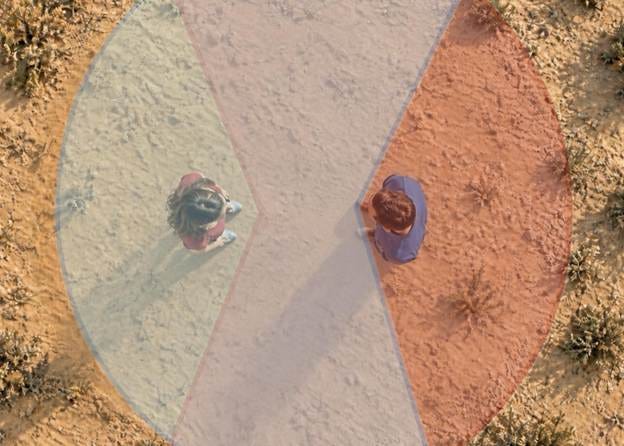
Incorporating the viewpoint of a second person into our field of vision extends the benefits provided by having two eyes, where a secondary point of reference allows us to gauge depth and distance. This secondary witness is not merely beneficial, but absolutely crucial in overcoming the more severe limitations of a single point of view. The overlap between the field of vision for each eye not only extends the total span of sight, but compensates for the blind spot present within each eye, the punctum caecum, where the optic nerves pierce the veil of the optic disc.
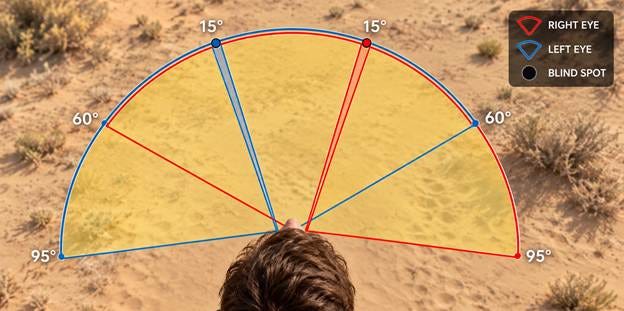
There is a simple test that can be performed to reveal our blind spot: close one eye and focus on a single point on a blank wall. Lift your thumb up in front of the spot, and move it slowly to the side, away from your nose, while maintaining your focus. At a certain point, your thumb will simply vanish, as your brain attempts to fill in the missing information that it cannot directly perceive with a representation, formed from the memory of what was supplied by the eye that is closed. The spot is small, but the point is important, as it demonstrates the impossibility of achieving absolute certainty via our own senses of perception.
The punctum caecum serves to demonstrate the same blind spot that permeates our broader field of vision, for which the assessments and representations of others can never truly be verified. Even though we can turn to see what is behind us, we are wholly dependent on representations for the perception of our own face. Videos and photographs provide us only with representations of what others view firsthand—and even mirrors can offer us the bent light of reflection, an inverted image of what is visible to everyone but ourselves.
The implications of our visual impairment are far more significant than those of our other senses. Even recognizing that our self-perceptions are distorted in comparison to our perceptions of others, every other sense is capable of self-assessment in a way that our eyes are not. We can touch, hear, smell, and even taste ourselves to various degrees, and the information gathered is sufficient for us to represent our own memories and experiences against the misrepresentations of others. As a solitary source, we may not be capable of convincing anyone else of what we know to be true, but the internal witness of our experience is often sufficient for our own convictions.
Photographs and reflections are sufficient for our self-identification, but the inability to directly see our face is the critical factor in recognizing the extent to which our own identities are socially constructed. Our ability to take on the risks associated with trusting any secondary viewpoint is largely dependent on our resilience, a quality that is deeply affected by the formation of our own identity, and this is where the limitations of representation can make or break us.
Long before we could speak as an I, our sense of self was being shaped by the thoughts, words, actions and glances pointed towards us as a second-person You. Every statement made about ourselves as individuals plays a role in shaping our self-perception, as we weigh the judgments and evaluations of others against our own observations to infer the validity of what we cannot perceive in ourselves. One cannot overcome the effect of being labeled as an outcast by your community through strength of will, and the attempt to refute the consensus opinion will inevitably meet resistance of one form or another.
A Cross-Cultural Mapping of the Face
The universal problem of representation extends beyond the punctum caecum and the inability to perceive our own face, and it affects every aspect of human self-perception, including our cultural identity. The concept of a socially constructed representation of the self is an explicit aspect of several cultures, best expressed in the Chinese concept of face, which lands in two registers.
The more overt and explicit form that embarrasses westerners, called Mianzi, measures “social prestige, status, public reputation, and the outward image others attribute to you. It is often performative and tied to success, wealth, connections, position, or conspicuous displays. It can be gained, given, padded, or lost relatively readily through social interactions. A wealthy but corrupt official might have high mianzi but little moral standing.”[1]
The second form, Lian, is more universally recognizable as similar concepts appear in other honor-based cultures: “Moral integrity, sense of shame, and basic human dignity or character as judged by the community. Losing lian (through ethical failure or shamelessness) is deeper and harder to recover; the insult “shameless” (bù yào liǎn) is severe. One can have mianzi without lian, but solid lian underpins lasting respect.”[2]
Western cultures, beginning with those rooted in Christendom and continuing onward into secular modernity tend to avoid the language of honor and shame, relying instead on the moral vectors of guilt and innocence, or empirical factors of true and false. Aspects of honor and shame culture have become more prevalent in the west since the introduction of the internet, and especially social media, as the explicit status markers of views, clicks, and algorithmic influence mirror the concept of mianzi, while cancel culture is firmly rooted in something like lian.
But such visible expressions are less reflective of a return to former practices, than a revelation of what has merely been obscured. While much of the success of the west can be attributed to a genuine shift away from honor/shame towards guilt/innocence, the deeper mechanisms of social inclusion and exclusion never really went away; they merely appeared to vanish.
The cultural magic tricks that allowed our social management mechanisms to slip out of sight are deeply tied to the problems of representation, as the feet continued to follow the well-trod paths erased from our cultural maps.
“Once a “map” emerges, a logic naturally arises that makes it moral to stay in and inconceivable to venture out—a process of insulation and “map-sealing.” Then, we employ “dominate strategies” in life to keep out anyone who would challenge our “map,” an act which also makes us seem right to stay in our “map.” After all, no one is able to pierce it; it’s safe. It should be our home (blood-bound).”[3]
Our history books are filled with bright lines and fixed dates that mark the arrival of revolutionary moments—the crucifixion, the magna carta, splitting the atom, etc. But the deep structural changes associated with these moments are secondary effects.
The driving force behind these movements was caused by the immediate shift in social standing provided by a new identity. The American Colonists did not wake up on July 5th, 1776, with a spiritual revelation about the moral superiority of self-governance; the only thing that changed was their allegiance to the British crown. The ideas and language introduced by the founders were important, and they would go on to have an impact, but the glue that held the revolution together was the solidarity of the people.
That sense of social cohesion, deeply primal, rooted in biology and thousands of years of tribal customs, is completely unrecognized in our collective understanding of the revolutions, because it is absent in the propositional arguments of the declaration of independence and the constitution. The human factor is part of the territory that was never written into the map, but it plays a critical role in how that map came to be interpreted by vanishing into the background assumptions of the cultural milieu.
“Once we map-seal and map-insulate with “blood” and “dominate strategies,” the next way to strengthen our “maps” and make them “indestructible” is by engaging in map-vanishing, which is to say by making our “map vanish as a map” into rather “is-ness.” If what we believe just “is” versus “be a map,” it’s all the stronger and more “indestructible,” …”True ignorance” is a powerful way to map-vanish, for if we are ignorant of everything that could reveal our map as being a “map,” then our “map” will easily become an “is-ness” (”practically” at least, for we will still easily know that in conversation we must speak more humbly). And everyone “practically experiences” their “map as the territory” (paradoxically), for otherwise it would lose authority and strength to guide and direct their lives. But so long as a map is “visible” as a map, it is still at risk of being seen as not the territory, and so there is an incentive to engage in map-vanishing. We try to “make the map transparent,” per se, which means we only see the territory through it. And then we don’t use a map-see, there’s just the territory? Indeed, “what is” is “what is”…”[4]
Outsourced Identity
Of course, nothing vanishes so easily as that which we cannot see, and so the socially constructed aspects of our identities in the west have slipped behind the veil of the punctum caecum, replaced by the script that says “We hold these truths to be self-evident, that all men are created equal, that they are endowed by their Creator with certain unalienable Rights, that among these are Life, Liberty and the pursuit of Happiness.”[5]
There is something ironic about launching a revolution on the basis of what seems self-evident, as it seems to suggest that the forces upholding the divine right of kings had been doing so out of willful belligerence for the last five or six thousand years. Not that the signatories of the declaration of independence were wrong, but the verbiage doesn’t quite reflect what was really going on. The revolution succeeded because it had uncovered territorial truths about the nature of human governance that were excluded from the map of monarchy.
The greater irony stems from the fact that founding fathers could indeed recognize that the map was not the territory. John Adams observed, “Our Constitution was made only for a moral and religious People. It is wholly inadequate to the government of any other.”[6] James Madison wrote that it required “sufficient virtue among men for self-government,” otherwise, “nothing less than the chains of despotism can restrain them from destroying and devouring one another.”[7]
The fact that they believed their culture was capable of producing such men in perpetuity suggests the ignorance of another blind spot regarding human nature. But the pattern becomes clearer as the context in which citizens have learned those famous opening words has shifted over the past 250 years. Madison’s concern was with the “The accumulation of all powers…in the same hands, whether of one, a few, or many, and whether hereditary, self-appointed, or elective,” which he said “may justly be pronounced the very definition of tyranny.” [8]
Perhaps the assumption that power might be seized was a projection of the revolutionary spirit; what he should have feared was the relegation of responsibility by the comfortable and content. Adams came closer, but his depictions of vice were likewise imagined as being too active in nature:
“But should the People of America, once become capable of that deep simulation towards one another and towards foreign nations, which assumes the Language of Justice and moderation while it is practicing Iniquity and Extravagance; and displays in the most captivating manner the charming Pictures of Candour frankness & sincerity while it is rioting in rapine and Insolence: this Country will be the most miserable Habitation in the World. Because we have no Government armed with Power capable of contending with human Passions unbridled by morality and Religion. Avarice, Ambition Revenge or Galantry, would break the strongest Cords of our Constitution as a Whale goes through a Net.”[9]
The fact that the greatest threat our nation would endure was completely absent from their imagination only serves to prove the point that seeks to slip away unnoticed. Our minds are lazy, and they do not like to waste time learning about things that seem unimportant. It is not difficult to believe that most normal people have a hard time emulating the thoughts of the more industrious and accomplished people that occupy the elite positions of our culture. But the inverse is equally true, though it is more difficult to believe. The active thinkers that crafted our founding documents lacked either the energy or the interest necessary to inhabit the minds of the lazy individuals who would someday vote in future elections.
We can see the effects of the vanishing context as the interpretations of those “self-evident” truths have changed within the last few living generations. “Created equal” has devolved into blank-statism, “unalienable rights” has become a trojan horse for socialism, and “the pursuit of happiness” that once justified free love and no-fault divorce currently serves to defend the sexual proclivities of psychopathic predators. How could the founding fathers of our nation make such a critical error? The outside observer would claim that the answers were staring them right in the face—but the face is the thing the maker of the map cannot see.
Rose’s map metaphors are particularly applicable to the American experiment. The formation of a constitutional government entailed outsourcing of authority once held by a monarch to a piece of paper. The map is a tool made by and for the explorers of the territory, and serves as a great aid to the mind who made it. Likewise, the Constitution extended the agency of the founding fathers who poured their wisdom into its creation. The combination of written rules and writing rulers created a structure of governance far greater than the monarchical structure of a solitary ruler. The dangers came when the writers vanished, and the written words remained:
“In the mythology of ancient Egypt, writing was an invention of the god Thoth, who promised it would improve the memories and wisdom of the Egyptians. Yet the wise king Thamus saw the negative repercussions of the gift, and was convinced they would do the exact opposite:
“For this invention will produce forgetfulness in the minds of those who learn to use it, because they will not practice their memory. Their trust in writing, produced by external characters which are no part of themselves, will discourage the use of their own memory within them. - (Plato; Phaedrus)
As we move towards a post-literary phase of culture, the warnings of King Thamus seem more prescient than ever. The physical requirements of working in paper and ink preserved some of the embodied wisdom within our literary systems. It’s eerie to consider what future archeologists might make of the blank and nondescript artifacts of our civilization, such as the smartphone. The ability to truly outsource our memories to devices is perilous.”[10]
The Filtered Face
As Jordan Peterson notes, “There are a trillion things to pay attention to. Almost all of them are irrelevant.”[11] The experimental data backs this up. Regardless of which representations we use to determine our highest valued, the evaluation we lean on hardest is what we deem not important. This reveals something critical about the eyes that see but cannot be seen. The eyes are a filter that hides those aspects of the world deemed unimportant.
The map helps us to focus on the details of the territory that others have observed, and our eyes are quite adept at finding correspondence with the details it presents. But we have no way of knowing what the eyes that wrote the map saw and did not mark. As we reinforce and relay our own views of the world to each other through various forms of representation, the signals reproduced become stronger and stronger, and the map becomes indestructible as every detail omitted from our representations slinks further out of sight.
A map that reveals the presence of key landmarks is a critical aid in navigating the complexity of the wilderness. A map that helps us sort faces into friends and foes is more problematic. A map that dictates our ability to perceive our own face is a dangerous trap.
Our sense of “Face” is composed of the internal representations of our identity that we have recognized and received from others, revised, reinforced and reaffirmed through repeated interactions. Those who have received abundantly tend to reciprocate broadly, and reject the reports of outliers that refute our established sense of self. The recursive application of representative constructs concentrates our perception of reality onto the signals most frequently repeated and reinforced.
The strongest signal is always the same; the majority consensus—repeatedly confirmed by the well-known Asch Conformity Experiment, in which a solitary subject is placed among a group of their peers who have been instructed to provide incorrect answers to a series of questions about the lines of different length. The fact that some 75% of individuals will choose the obviously wrong answer speaks volumes about the more nebulous facts of reality commonly held. Many people admit that they knew they were making the wrong choice and are aware enough to recognize that they were afraid to stand out. But not everyone does. Some defend their choice as an honest mistake, and a very small minority maintain that they were correct even after the nature of the experiment is revealed.
The results of the Asch test are not universal. Conformity is higher among cultures with an explicit concept of “face”, and the results have also changed over time. Subjects have become more willing to assert themselves in the several decades since the test was first introduced in the 1950s. The decrease in conformity tracks with an increasing emphasis on authenticity and individualism, and while it certainly seems like social cohesion is in decline, the need for group identity has not diminished. The changes simply make it harder to see where conformity is still a dominant factor.
America began as a nation populated by outliers, including outcasts and opportunists. Rugged individualism is a genuine part of our pedigree. That made us both an outlier and an outcast among the nations, until our eventual success made us the object of imitation. The power of the collective was permanently cracked by the deployment of a single Atomic bomb, and destroyed in the repeated success of its secondary deployment, cementing the symbolic power of the one against the many.
But rather than adopting the American values of self-determination, the collectivist cultures on the other side of the ocean simply weaponized their penchant for social conformity to master the methods developed to defeat them. The mechanisms of honor and shame were relocated towards the workplace and the markets, measured in financial gains. Japan became the global center for corporate research and capitalist financing, while China mastered the arts of reverse engineering and mass manufacturing. While the reappropriation of the methods led to unprecedented prosperity, those cultures are now leading the global race to a population collapse.
The decline can be explained by the simple, self-evident results of the culture of the individual conquering the collective. There is little point in reproducing conformist children in a world where the strength of the many has been crushed by the power of the one. The hidden logic behind China’s one-child policy likely had less to do with limited resources than an underlying belief that success must lie in concentrating developmental attention towards the creation of exceptional individuals. This way of thinking is most clearly visible in South Korea, where parents pour enormous resources into private education to prepare their children for the CSAT exam, a single test which essentially dictates the entire life of students. The high resource cost incentivizes parents to have fewer children, or invest all their time and effort into the success of their first born. There is a massive spike in suicides following the test every single year, as individuals are revealed to be unexceptional.
These cultures have always had impressive individuals, but they also had laws and structures that dictated where those people would come from. Class distinctions dictated the scope of your achievements. The collectivist cultures allowed individuals to pursue excellence with the conviction that they were pursuing destiny, by relegating everything outside their pre-determined path to the realm of not important. The son of a baker might have aspirations to work in the palace of a king, but he would never dream of sitting on the throne. The fantasy was so far off his map that it never entered his mind. The triumph of the American dream destroyed the “is-ness” of that predictable reality.
But while the power of individual agency was hiding in the blind spot on the cultural map of the East, the West was turning it into a cataract that obscured the significance of social cohesion and group identity. In the 1950s, Albert Ellis applied that war-winning cowboy mentality to the field of psychotherapy to develop Rational Emotional Behavior Therapy. Ellis’ core insight came from the Stoic philosopher Epictetus, who declared that “Men are disturbed not by things, but by the principles and notions which they form concerning things.” This distinction became the foundation of Ellis’ approach: activating events do not produce emotional consequences by themselves; the intervening beliefs do.
The insight fit the American ethos like a hand in a glove. Instead of spending countless hours listening to patients lay on the couch talking about their childhood, the therapist could empower his patients to pick themselves up by the bootstraps and get on with their lives. A parallel model developed by Virginia Satir employed “I am Me” declarations to emphasize that each person “owns” their own feelings, thoughts, and responses. Once the idea moved from philosophy into clinical technique, it became a standard therapeutic assertion that one is responsible for one’s interpretations and therefore for the feelings those interpretations generate.
These ideas eventually spread like early memes through self-help books and pop-psychology shows, compressed into pithy slogans like “You are responsible for your own feelings,” and “Someone else doesn’t make you feel anything.” Upon entering the popular lexicon, the therapeutic value of such statements was quickly stripped, as they became weaponized excuses against the easily offended. It doesn’t take a genius to recognize how telling everyone that they were responsible for their feelings regardless of the actions of others created a field day for the dark triad personality types. Self-ownership took its most toxic turn when it was applied in parenting, and it was especially burdensome to children with a greater degree of sensitivity.
But these problems went beyond mere misapplication, as the entire notion was a genuine misunderstanding of the role that other people play in our emotional regulation. Our current understanding of how nervous systems operate refutes the claims almost entirely, at least as it is commonly understood and transmitted. (This new knowledge has also been weaponized to create the opposite effect, where no one is responsible for their own feelings, but that is an issue that requires separate treatment.)
In our individualistic culture, the general acceptance of extreme self-ownership, self-responsibility, and self-determination serves to hide the role that a socially constructed “face” serves in forming someone’s identity, especially when paired with the common assumption that the “authentic self” is a sort of essential substance discovered by the individual. Rather than acknowledging the extent to which our identity is actually built up by second-person representations of the “you”, such statements must be either taken as either true or untrue observations and revelations based on the sensory perception of the speaker. While obvious and egregious statements may be understood as projections, as in the blatant deceptions of the Asch test, it becomes almost impossible for someone to recognize how much the more subtle projections, whether flattering or detracting, are being taken as truth, and incorporated into that hidden “face” identity.
The Self-Consuming Face
The problems produced by the recursive reinforcement of this self-determination are perhaps best understood by recognizing what would have occurred in the collectivist culture of Japan without the reality-breaking intrusion of the atomic bomb. Many historians have noted the extreme dedication of the Japanese military, a direct result of their honor culture, which viewed the loss of face as a fate worse than death. The deployment of kamikaze pilots was not a tactical decision aimed at victory, but meant to prove the ultimate superiority of Japanese culture. It was not a utilitarian duty to make use of the pilots deemed most disposable, but an honor reserved for the very best. Likewise, the final chapters of the war saw Japan arming the malnourished remnants of their citizenry—the elderly, women, and any children old enough to hold a weapon— for an equally suicidal final defense of the homeland. If the bombs never fell, Japan would have continued fighting to preserve honor at the expense of their very existence.
O.G. Rose points out that this is not an aberration, but a consistent result of outsourcing understanding to a representative “map” of reality:
“a map that denies facing the reality that it isn’t the territory (or “The Real”) is vulnerable to “autonomous rationality,” which suggests the wisdom in ‘Chesterton’s aim [to] thus […] save reason through sticking to its founding exception: deprived of this, reason degenerates into blind self-destructive skepticism: in short: into total irrationalism’ (autocannibalism and self-
effacement).” [12]
The problem comes not from a critical error in what a culture perceives, but from the double-blinding of a limited representation (the map) and the filter through which it is interpreted (the blind spot that hides whatever the map deems “not important.”) The fatal deception holds firm because it is not a delusion. The reality that is perceived in the map through filtered vision is reality; the truth of representation comes directly from the territory:
“We should make clear that “the map” and “the territory” do not share in a dualistic or clear-divide relationship: the map comes from the territory and is itself part of it (reflexivity is integrated in, as Gödel understood). This also suggests another reason why “the map is indestructible,” precisely because “the territory is indestructible” (unless we don’t exist), and the territory (essentially) emerges to maps. The way Žižek describes “The Real” could be useful here: ‘The Real is thus simultaneously the Thing to which direct access is not possible and the obstacle that prevents this direct access; the Thing that eludes our grasp and the distorting screen that makes us miss the Thing.’ So it is with the territory: it is what we cannot access, and that which consists of and generates the maps which keep it inaccessible. And where there are maps, there are opportunities for self-deception, ever-deferring desire, totalization…(‘the idea of overcoming is sustained as a deferred moment of reconciliation without having to go through the pain of overcoming as such’). To live is to live with fire.”[13]
The totalizing (lack of) vision caused by the interactions between our limited maps and filtered vision inevitably results in the auto-cannibalistic consumption of a serpent swallowing its own tail. The world notices when a united people begins to slide into self-destruction. But when that consumption is limited to the outcasts, the fate of those unfortunate individuals is viewed as unimportant—their destruction only serves to reinforce our allegiance to the map, a necessary sacrifice that strengthens the warnings to avoid the monsters lurking near the edges and reaffirms our faith in the safety at the center.
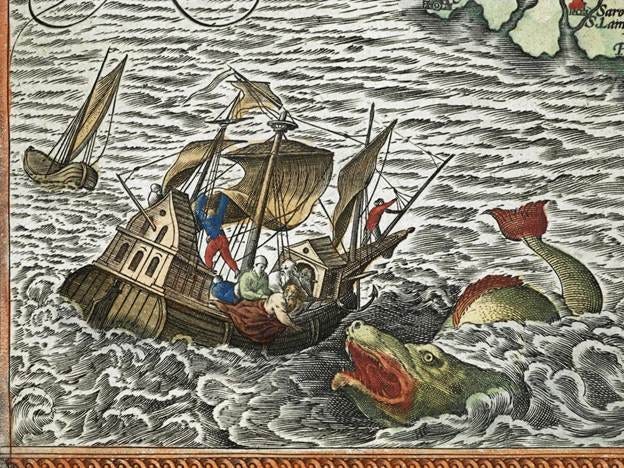
The prophet Jonah is tossed to the sea monster to quell the storm
But the dangers present on the map are never the causes of our destruction; childhood trauma, mental health issues, substance abuse—the visible monsters are only symptoms of the true disease. We are consumed by the reality we cannot see, and cannot face. Thus, in our own culture of guilt and innocence, where everything is based on objective truth and empirical observation, we have swallowed the socially constructed aspects of our identity as a poison of panic and anxiety that is eating us from the inside. The sense of “face” has not vanished from our culture, it simply hides in the darkness of the punctum caecum of the authentic self—a mask so convincing that we mistake it for our true identity.
Because it is more hidden, subtle, and less overt, any revelations that result in the loss of “face” are even more destabilizing than the Eastern loss of shame. One can accept being labeled “shameless” (bù yào liǎn) and survive as an outcast, or choose to refute the claim with an honorable death. In a culture where identity is owned and determined by the individual, the revelation that your face is a mask consumes our very concept of the self.
Respecting the Vision of the Unfiltered Eye
The sudden realization that reality possesses dangers that are absent from our representations, and imperceptible to our vision results in an inevitable sense of fear and anxiety. We can sense the presence of forces beyond our understanding, but without some means of explanation, our imaginations run wild. We can see this in the current frenzy to reclaim former representations that accounted for the unknown via various forms of spirituality, conspiracy theories, and science-fiction inspired projections of both dystopian and utopian futures.
