

This is the third entry in a series on the documentary You Can See Everything. The first post is available here, and the second post is available here.
The Map is not the Territory, and the Word is not the Thing
In the final episode of the first season of Nathan For You, Nathan takes it upon himself to boost the public profile of Brian Wolfe, a private investigator whose business is being hampered by a lack of Yelp reviews. To determine if the investigator is worthy of five-stars, Nathan hires Brian to track his own whereabouts for the next 24 hours.
The comedic twist comes in the form of eight actors of various ethnicities who look “identical” to Nathan, disbursed in a swarm of misdirection from a hotel lobby. Nathan sends Dan, the most convincing body double to his home, with instructions to make his performance convincing by cleaning his apartment.
Nathan in turn assumes the role of Dan, but loses interest in the scheme when Dan’s fiancé reacts poorly to his presentation of flowers, wine, and condoms. In his despondency, Nathan surrenders to Brian, asking if he would like to go get a beer, before attempting one last evasive maneuver, running away on foot, as an asian “Nathan” climbs into the passenger seat of Brian’s truck.
Despite the obvious absurdity of the on-screen portrayal, the body double plan would be quite effective under different circumstances. Barring a few disparities, the basic description of a slim man with dark hair and dark eyes, wearing a blue shirt and khakis might lead an investigator or sketch artist to identify any of the doubles as potential suspects, or useful decoys to help a witness identify someone in a police lineup.
The joke hinges on the discrepancy between the apparent face blindness of Nathan’s quasi-autistic character, reinforced by the redundancy of the photo dossier that Nathan presents to Brian. The visual gag serves as the perfect illustration of Alfred Korzybski’s famous maxim that “the map is not the territory”. The philosophical dilemma regarding the relationship between objects and their representation has profound implications on the enigmatic reception of You Can See Everything.
But Korzybski’s theories provide the basis for exploring a deeper level of obfuscation across Fielder’s greater body of work through a second maxim, that “the word is not the thing”. Fielder has played at least four different fictional characters named Nathan Fielder (or simply Nathan) across a variety of different series.[1] But as each version exaggerates and diminishes different aspects of his “real” personality, the lines between performance and reality begin to blur. By the final episode of The Rehearsal, the distinction is virtually non-existent, as it is undoubtedly the real Nathan Fielder who takes to the sky in a real Boeing 737 to explore the very serious problem of cockpit communication between pilots and co-pilots.
In his single-paragraph story “On Exactitude in Science”, Jorge Luis Borges uses the map–territory relation to highlight the problematic nature of representation as a necessary reduction of reality. A map is by definition incomplete, and therefore inaccurate, but without it, the details of the environment threaten to overwhelm the senses. This doesn’t mean that a representation is false; its accuracy is based on its correspondence to reality. A map can contain mistakes, but its accuracy can be verified by comparison with the territory. We don’t care about the placement of every rock and tree so long as we know when to turn left or right or trust the cardinal directions of a compass.
But when we navigate life by means of representation alone, our ability to distinguish the difference between an object and its representation atrophies, we dismiss those aspects of reality that do not meet our expectations. If we are searching for a triangular peak based on an abstract symbol, we can dismiss the subtle incline of a mountain right in front of us. This is the issue at the heart of the controversy surrounding You Can See Everything. A documentary is meant to be a representation of reality, but it is by definition a map, and not the territory. The problem is further exacerbated by the labeling of each character, as the word is not the thing, and the diagnosis is not the person.
Map Readers and Explorers
Out of 87 sources I collected on and around the topic of the film, two broad camps emerged, representing distinct approaches to evaluating the film. The first group, whom we will call the map readers, comprised 37 sources that offered a definitive judgment about at least one of the principal characters. The second group were the explorers; 32 sources were more focused on philosophical questions regarding the roles of narrative and meta-narrative, the ambiguity and uncertainty of “knowing” other people, and questions about the nature of media and representation. (The other sources included interviews, background information on Fielder, Holmes, Theranos, and discussions on the box-office success and cultural excitement surrounding the film.)
Among all the sources, there were eight singular moments that various commentators cited to make a critical judgment of the characters involved. These scenes were the egg-whisking scene, the “Who’s on First?” sketch, the single teardrop, the “I did not” non-contraction defense, the cold ocean swim, the full-frontal shower scene, the Charlie Kirk dinner argument, and the single-word script edit (from “it” to “something”) during the fireplace prison reenactment session.
Each commentator that produced a judgment cited between 1-5 of those critical moments, along with a handful of 20 supportive moments to make their case. The top five, cited in more than ten sources, include Billy interrupting interviews to stop camera footage, Amanda watching Elizabeth watch The Dropout on the couch, Billy negotiating A24 backend profit points behind Elizabeth’s back, Elizabeth unpacking the MiniLab (”can” vs. “could” semantic defense), and Billy watching biology videos on 2x speed in bed.
The table below shows the specific judgment each source uses for each character, its general posture (positive, neutral, negative) and how many moments they cited to support their case:
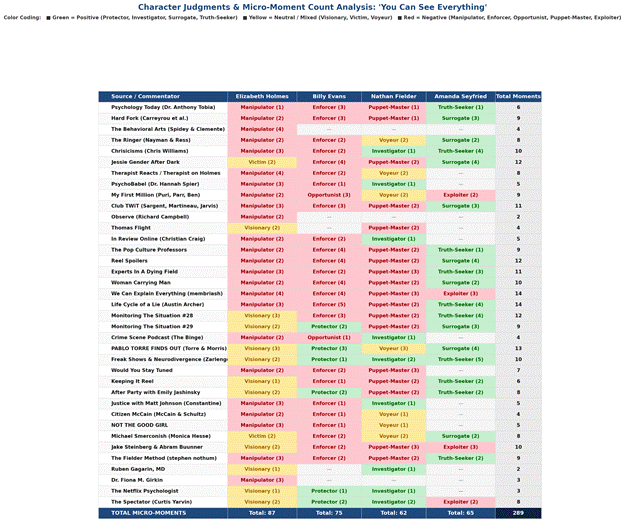
While both camps cited the same eight critical moments, they did so with a different emphasis. Among those making character judgments, (the map readers) the egg whisking scene was the most critical, while the script edit and the cold-water swim were least important.
Conversely, those same two scenes were among the most important to the explorers, just after “Who’s on first?”, which was cited in 24 of the 32 sources, while the only scene mentioned less frequently than the egg-whisking incident was the “I Did Not” Non-Contraction Defense. These sources also cited 16 of the 20 secondary moments mentioned by those making judgments, while mentioning five more scenes ignored by the other group: The David Blaine “ice-pick through the hand” speech, the “MacBook in a BabyBjörn” breakup confession, the framed prison crib visual composition, the staged set-dressing of the beach house, the A24 executive “kill-switch” debate.
The table below cites the various non-judgmental sources, their themes, stances, and critical moments:
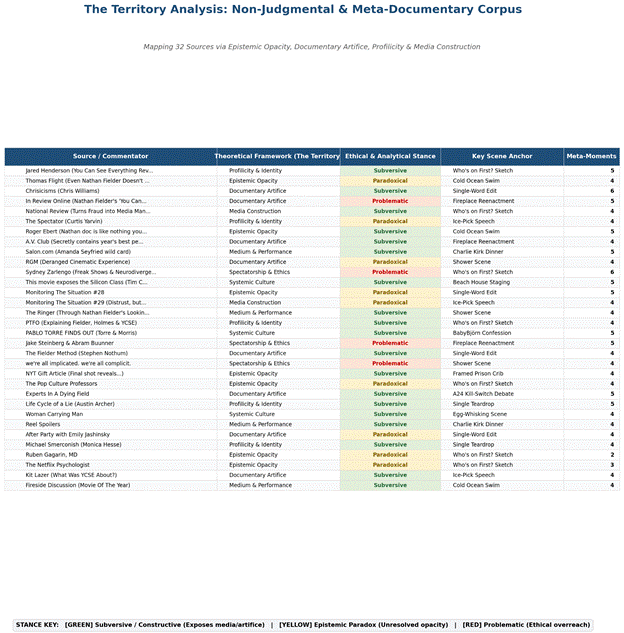
The massive disparities that exist not only between the two camps, but within each, highlight the breakdown of our sense making protocols. Those focused on making character judgments, by operating on the assumption that a documentary is a map of reality, reveal how small a sample is needed to verify an assumption about someone’s character.
Nathan Fielder and Lance Oppenheim filmed Elizabeth and Billy with multiple cameras for roughly sixteen hours a day, for thirty-four days, capturing over a thousand hours of footage to produce the first 85 minutes of the documentary, reducing to approximately 0.13 percent. Six of the eight critical scenes were filmed during those 34 days, with five being presented chronologically, while the swimming scene is not revealed until the second half of the film.
On average, judgments were made on 2.26 moments per character, with none citing more than five.
We actually see this judgment occur in real time, as Amanda Seyfried views the footage on Nathan’s laptop. The 85 minutes it takes to view the footage is further compressed into 2 minutes and fifteen seconds. We see her reaction to the egg whisking scene, and immediately after viewing, her judgment of Billy’s character is already formed:
Amanda: “I wish there was a way you could find some shit on Billy, bring it to her. Find a way to break them up.”
Nathan: “You want them to break up?”
Amanda: “No, find some shit on Billy. Yeah, of course I do. No woman wants to see another woman be controlled by a guy like that.”
Amanda later puts a name to the pattern in her mind for her judgment of Billy—narcissist. The egg whisking was enough to match the symbol on her map to the silhouette of the man. Once the initial judgment is made, each thin slice of footage that confirms it stands out, the remaining details become irrelevant.
When given a description like “a slim man with dark hair and dark eyes, wearing a blue shirt and khakis”, this kind of thin slicing would not be able to distinguish between nine different Nathans. Nor does it need to, when it is employed by a casting director who is trying to maximize the absurdity of a gag by filling a hotel room with vaguely similar bodies. But the map and its labels blinds the viewer to what is filtered out. Labels like sociopath, narcissist, and felon accentuate the features required for confirmation, and diminish our capacity to perceive the features that would jump out by those focused on other terms, like mother, father, or friend.
The other camp is mostly aware of this distinction, and tends to suspend judgment for that very reason. But the lack of agreement points to another issue that produces its own set of problematic coping mechanisms. Awareness of the map-territory relationship does not preclude one from mistaking the map for the territory. Indeed, this is a perpetual problem rooted in the inherent limitations of our perception, explored in films like The Matrix, and its philosophical antecedent, Plato’s allegory of the cave.
If the map readers are held captive by their desire for certainty, the explorers reveal the seductive draw of endless speculation and ambiguity. This group is mainly composed of those we would consider outliers, including many who blur the line between outcasts and elites. Philosophers, artists, and critics are certainly more aware of the complexity of the territory, and the usefulness of maps and models. They enjoy the twist endings that disappoint the masses, and derive a greater sense of joy from the novelty of a new experience than the confirmation of their expectations.
The hazy narrative of You Can See Everything presents a conundrum for many of these viewers, as it
openly invites questions about the nature of fact and fiction, between reality and representation, and even between participation and observation. This last distinction is especially important, as each judgment and opinion published is shaping perceptions of the film, and its subjects. Unlike The Dropout and Bad Blood, the lack of a satisfactory conclusion is forcing people to adopt one of Fielder’s favorite strategies for processing truth in narratives; going meta.
Magic and the Meta-Move
Throughout his career, Fielder constantly reinterprets events by exploring layers of context. Instead of starting with the surface of the map, he fixates on superficial details—a wet penis, a bowl of eggs, a single word like can—expanding the context outward, revealing the shape of an onion from the inside.
