Conservatism, as a mindset, is antithetical to the creation of good art. As Roger Scruton said, “The basic premise of conservatism is that worthwhile institutions are hard to build, and easy to destroy.” But this is wrong. God created everything in six days, and the most worthwhile things in life are often grasped in a single instant. Things are most often hard to build due to inefficiency and indecision, not because it’s so difficult to make good things. In practice, conservatism seems far more centered on a frustration over sunk costs in obsolete methods.
Creation is inherently destructive; there is no way around it. There is no gentle means of creation. Building anything requires cutting trees, mining stone, and melting metal. Even the peaceful growth of newly budding plants in spring comes as a result of the sun’s continuous explosions. A growing body requires the constant destruction of countless cells. Any additive process requires material that must first be subtracted from an intact source to do anything good.
A House Divided
The best place to understand the bind that conservatives find themselves in is their schizophrenic defense of Tolkien and Lewis. Conservatives love these authors because they are both old and Christian, two of the modern conservatives favorite things. They also like to highlight the fact that the authors were good friends. Yet they fail to reckon with the fact that they were artistic enemies. Perhaps Lewis did not see Tolkien as his enemy, but that’s certainly how Tolkien saw Lewis. One can scarcely imagine the vitriol he might have expressed if The Chronicles of Narnia had been written by someone who wasn’t his drinking buddy.
In the artistic sense, only Tolkien is a conservative, and his great work has been proving a stumbling block to conservative art ever since it was first published. The Lord of the Rings has proven to be a black hole for creativity, and it only grows stronger over time. The work is often cited as a masterpiece, a kind of new mythology for the modern age. This description is entirely accurate, as it is precisely what a modern academic would expect in an introductory text on a new subject from one of their peers.
Much of the confusion regarding LOTR stems from the fact that it was erroneously published as a work of creative fiction, which led many would-be novelists to foolishly attempt to imitate it. Initially, their lack of familiarity with established academic practices, and the specific knowledge of ancient myths and languages had little impact on their initial commercial success. But as comparisons continued over time, readers became increasingly cognizant of what set LOTR apart from other works of fiction. This led a majority of would-be authors to lay down their creative dreams and pursue a career in the burgeoning new field of Tolkien scholarship.
Tolkien famously denied drawing any inspiration from Richard Wagner’s ring cycle, which was probably true according to his own idiosyncratic standards, but his autistic obsession with internal consistency and technical minutiae inadvertently reproduced the precise kind of bureaucratic sclerosis famously portrayed in The Master Singers of Nuremberg, in which the town’s craftsman have codified the rules of their art with such precision as to make it impossible for any outsider to successfully join their guild. After watching a generation of authors be ripped to shreds for failing to live up to the standards of the philologist’s fan club, creative fantasy finally recaptured the zeitgeist when authors embraced a decidedly anti-Tolkien position in style, plot, and theme. As noted in this video, grandpa Tolkien’s books tend to bounce kids hard, and anyone who felt superior for realizing its brilliance at the age of 9 or 10 ended up in academia with the only other people who cared.
The Lord of the Rings is well suited for this kind of conservatism. It has a canon, historicity, definitive pronunciations, and a list of officially sanctioned opinions that grows more concrete every time a new PhD is drawn towards the gravitational pull of middle earth. A certain Tolkien-stan who I will not mention by name, because they previously blocked me on X, said that he was confident that The Lord of the Rings would endure for centuries, if not millennia to come. He wasn’t sure how long the Narnia books would remain popular, but he was far less optimistic, for all those nerdy reasons.
But these techniques, and the corresponding impulse to complain about what is new and different, fail miserably when applied to the work of C.S. Lewis. Of course, the reason why people are talking about this is because of the upcoming film release of The Magician’s Nephew, and the recent trailer, which looks pretty good overall.
Was Lewis Liberal, or Simply Courageous?
As a baseline, I will refer readers to Bethel McGrew’s very good article in which she highlights many of the points I plan to address. Others have been drawn from the collective reactions of various commentators on X. She’s a self-proclaimed curmudgeon, and I don’t fault her for being consistent; I merely hope to point out why these positions begin to feel so burdensome, and explain how they have caused so many conservatives to miss what is actually going on.

Lewis’ work is too sparse, too convoluted, and makes too many conceits to the limitations of readers to be upheld to rigid standards of canonicity. Ironically, this is exactly what Tolkien didn’t like about Lewis’s stories. He hated the mishmash of all kinds of diverse influences, and the obvious clarity of Lewis’ moral lessons and religious symbolism. But unlike The Lord of the Rings, Narnia was written for kids, kids were capable of reading them, and kids liked them.
This is the second round of controversy surrounding this film, or maybe the third, if the fact that Greta Gerwig, a woman, was first announced as the director was a controversy. If not, the supposed casting of Meryl Streep as Aslan definitely was. The more recent news that Streep’s voice has been altered into oblivion, suggests that suspicions about the casting-for-controversies-sake were accurate; and why wouldn’t they be? Since the whole ethos of the conservative cultural movement is to be as predictable as possible in your reactions, they can be reliably counted on as a good source of free advertisement.
I addressed these concerns on X when they were first announced:


First, the concerns about feminism. It seems likely that Polly has been cast as somewhat of a girl boss. I don’t know why people seem surprised that the girl-boss director who keeps being wildly successful at creating movies with girl-boss characters would create a girl-boss character for this one. Many conservatives, especially male conservatives, seem incapable of distinguishing between competent female agency and radical feminism. As a father of daughters and someone who is married to a competent woman, I can confidently say that not only is there a difference, but the failure to recognize such a difference is almost certainly a contributing factor in the involuntary celibacy of many young conservative men. I would even go so far to say that you can disagree with Gerwig’s brand of girl boss as a conservative, and still recognize that it is a preferable vision to what many conservatives have in mind for young women.
Next critique, Led Zeppelin. This is Trad butt hurt. The boomer generation gave us exactly one great cultural artifact, and it was Rock music. Gerwig said that the music inspired her creativity, and I can believe it. I have a vivid memory of the first time I heard Led Zeppelin’s Achilles Last Stand, an epic, 10-minute song full of long instrumentals, while reading Kurt Vonnegut’s The Sirens of Titan. I don’t remember much about the book off the top of my head, but the combination was powerful; somehow it just fit. Other folks were sharing a version of the trailer sans music, and for some reason were surprised to discover that it was worse.
This conservative fear/discounting of the power of music is probably why Tolkien couldn’t recognize the similarity between his work and Wagner’s. It was all subconscious. But let’s face it, if you’re gonna try to put that singing-the-world-into-existence scene from The Silmarillion onto the big screen, it’s gonna sound a lot like Wagner. Of course, Lewis probably was thinking something closer to that register for Aslan’s song as well; but he wasn’t a big enough nerd to compose the score and include it in an appendix at the back of the book. He was OK letting somebody else draw pictures, and letting children imagine things for themselves.
This brings another point of contention of mind; the space age look of the world hopping scenes. I’m not sure what most conservatives think that the wood between worlds really was, nor do I think that Lewis put nearly as much thought into designing the physics of that space as the average Tolkienista would expect. If we want internal consistency, look at the green lady’s argument from The Silver Chair. Kids can’t explain anything magical except by pointing to bigger versions of the things they already know. In Victorian England, it was doors and wooded gardens and little pools of water.
Kids these days have been seeing portals and wormholes and outer space scenes in cartoons for decades. That kind of visual language makes sense to them. What the heck is a wood between worlds anyway? A psychological projection for making sense of some kind of DMT dreamscape? Because that’s how a literal portrayal of what is written would likely be interpreted. If Lewis thought that kids were up to date on science fiction, he probably would’ve put that stuff in there. His own pre-space-age science fiction novels don’t hold up to that kind of rigorous testing, but the attempt at accuracy suggests that he might appreciate the modern upgrade.
And this brings us to the final criticism; the time changes. Lewis set the magician’s nephew in the Victorian era, as Digory, its chief protagonist, is an old man during the World War II era of The Lion, The Witch, and The Wardrobe. Gerwig has moved the magician’s nephew up into a 1940s-50’s timeframe, which seems to imply that the later stories will likewise be pushed forward in time. Conservatives will no doubt be concerned about this change, as events of World War II are also part of a sacred mythos, and it was the need to escape the air raids that caused the Pevensie children to be relocated to the country where they first encountered the wardrobe. But treating this series of events as holding great canonical significance misses the entire point of the original setting. The only reason Lewis set his story in that time it’s because it was immediately recognizable as recent history.
Narnia is a story about entering a fantastic new world from the here and now. If someone needed a recent event to point at when children might be isolated and bored enough to encounter such an adventure, it would probably take place during the Covid lockdowns. Of course, the wardrobe was already a minor anachronism in 1950, but today it is a relic that is only known through Lewis’ story. A director could choose to preserve that detail, since it’s in the title of the book; but the original intent of Lewis’ story might be better served with a completely new mode of transportation. A broken elevator in New York City, a forbidden stairwell, a walk-in freezer—anything would do, since the modes of arrival vary from book to book, modern innovations would only serve to perpetuate the true mythic nature of Narnia. Anyone who doubts the consonance with Lewis’ sentiments can read his own explanation for setting his Arthurian fairy tale, That Hideous Strength, in the present day post-war period:
“I have called this a ‘fairy tale’ in the hope that no one who dislikes fantasy may be misled by the first two chapters into reading further, and then complain of his disappointment. If you ask why—intending to write about magicians, devils, pantomime animals, and planetary angels—I nevertheless begin with such humdrum scenes and persons, I reply that I am following the traditional fairy-tale. We do not always notice its method because the cottages, castles, woodcutters, and petty kings with which a fairy-tale opens have become to us as remote as the witches and ogres to which it proceeds. But they were not remote at all to the men who made and first enjoyed the stories.”
And this is why it is quite likely that Lewis’s stories will actually survive longer than Tolkien’s; at least in spirit, if not in their exact wording. Both authors would readily admit that such teleportations to the present day were part of the longstanding traditions of myths and legends. The real Arthur, if he lived, would have lived somewhere in the sixth century, long before the plate armor and heraldry and formal jousting tourney’s that occupy so much of the drama that came to define the mythic nature of Camelot. Those legends developed through a continuous process of additions and subtractions in various retellings that blended the past with the present in a fashion more akin to Lewis than to Tolkien.
More conservative griping:


Likewise, there is much of antiquity in Narnia that may not always resonate with the times and places of those who wished to tell new stories. Perhaps Santa Claus will endure, but Bacchus may not. No bother; Lewis’ mish-mash of different tales invites new substitutions. It’s not difficult to imagine Aslan walking side-by-side with Albus Dumbledore and Harry Potter. After all, J.K. Rowling, author of the best selling book series of all time, is clearly the successor of Lewis, more than Tolkien.
Conservatism’s Failure to Subvert The Creative Impulse
Rowling has expressed a great deal of generosity towards the imaginative interpretations of her fans, including fanfiction. While this open stance has the potential to dilute the impact of her original stories, it may serve to elevate Harry Potter above Aragorn and Aslan, to the legendary status of Arthur and Merlin. But while the Arthurian canon evolved over centuries, the Harry Potter lore is undergoing rapid transformation via the increased connectivity of the internet, and the creative potential of AI. The most recent example is a viral revision and expansion of the original story that transforms the male antagonist Draco Malfoy into a female love interest. Rather than subverting the core narrative, the twist seems to carry the potential to shore up some of the weaker points in the character arc of the villain, and the overall resolution.
As some fans have noted, the inexperienced Rowling may not have quite mastered the knack of writing a convincing male villain, and Draco already came off like a catty mean girl. But the revision seems to address larger structural issues, as noted in this tweet:


As for the implications for the future of writing, storytelling, and intellectual property disputes, Matt Crott’s scrollers podcast hosted a lively discussion on the “Malfoid” phenomenon. The knee-jerk reaction from older conservatives to the Malfoid trend was to criticize it as a woke gender swap. But the trend reveals deep longings in the younger generation of conservatives. The appeal of this alternate story is rooted in the challenge of winning over a smart and competent woman, which elevates Harry into a far more chivalrous and knightly hero.
In essence, Malfoid reflects the only move that will actually heal our divided culture, as young men and women are increasingly split along political and ideological lines. The conservatives keep telling their sons to find a safe conservative woman. But men long for a challenge that causes them to rise to the occasion. They want to earn the loyalty of a truly worthy partner.
But the speed and virality of the malfoid phenomenon reveals something even more critical about the true purpose of good art. Art is often most potent in its first glimpse, when it allows us to see through the paint and pixels to behold a vision of the sublime. That is what Malfoid is conveying through viral memes and AI slop. The Lord of the Rings produced such moments twice, in its initial publication, and again with the release of Peter Jackson’s film trilogy. Creative engagement like fanfiction works to shape the heart of the creator as the vision takes shape. Sometimes, exploring the alternative serves to prove the brilliance of the original, and if a work is as brilliant as The Lord of the Rings, conservatives have very little to fear from such efforts. Other times, it exposes the limitations of a work and delivers something greater, often transforming into entirely new works and new worlds.
The creative impulse is inherently disruptive, and it tends to poke at whatever limits it encounters. When conservatism spends all its creative energy reinforcing walls and sealing cracks, it dulls the creative spirit within its adherents, and drives the most determined creatives towards direct opposition. The revelation of both Gerwig’s adaptation and the Malfoid trend is that the conservative impulse to protect canonicity through bureaucratic gatekeeping can’t stop the creative drive. What it can do is keep the conscientious rule followers out of the game; and this is where the “conservative” mindset becomes an obstacle to many conservative values. The disdain for conservative values among so many creatives is directly correlated with a conservative mindset of fear and suspicion.
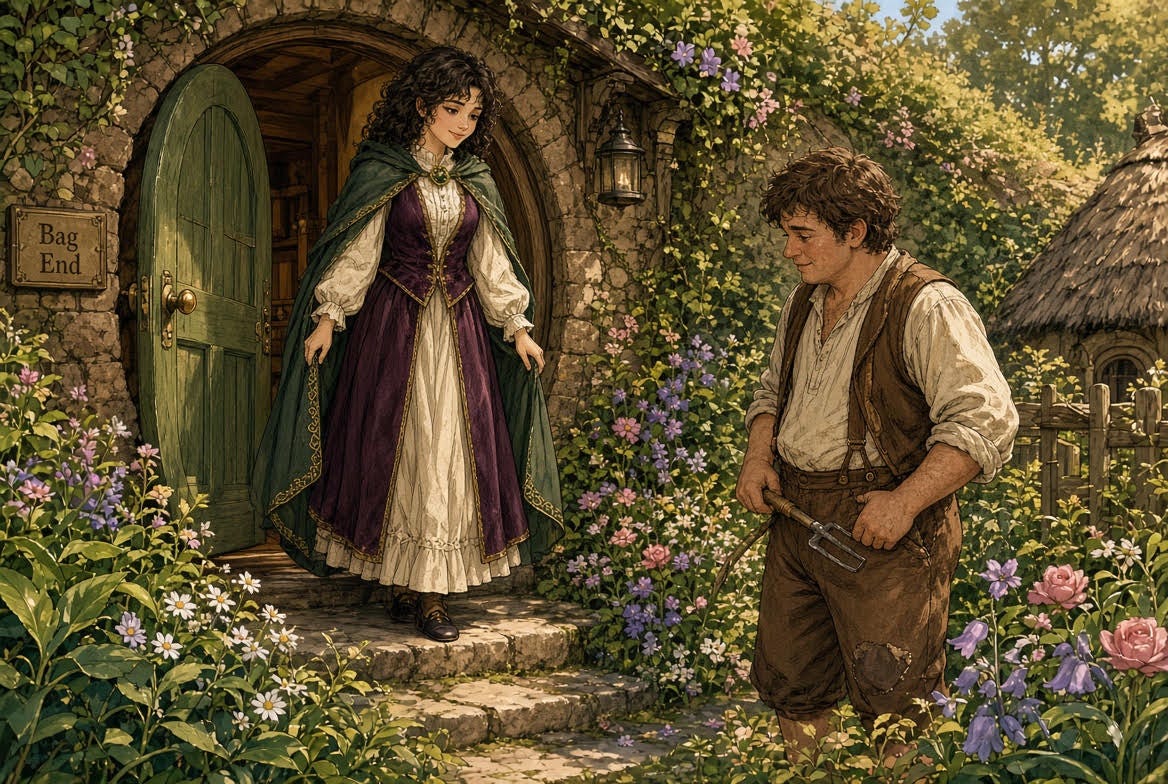
Conservatives can’t keep people from messing with Tolkien, but their dogmatic gatekeeping means that the only real creative engagement is practiced by their ideological opponents. As far as I can tell, the only acceptable creative outlets for Tolkien fans is canonical cosplay, model building, and book decoration. Tolkien fan-fic exists, but it is entirely written by leftist liberals, and overwhelmingly centers on LGBTQ identity politics, and homosexual romance. Fans have been “shipping” Frodo and Sam as lovers for decades. None of these stories have reached escape velocity because they don’t resonate with the deeper longings of the upcoming generations—and neither do the originals. For Tolkien’s epic to endure, it must be released from the fearful constraints of conservatism. It might even be capable of capturing the divided imaginations of both male and female readers. Perhaps in the form of an upstairs/downstairs class-based romance, with a healthy dose of traditional female competence. The young men don’t want to settle for sensible Rosie Cotton; they want to prove they are worthy of winning over Foido Baggins.