

For the better part of the last two years, I have been writing fiction, and researching and writing essays on philosophy and theology that explain and inspire the fiction. In a recent conversation with Daniel Garner (O.G. Rose), who employs a similar methodology, we discussed how the two modes of fiction and non-fiction work together to answer the same questions in different ways. This process is not limited to the practice of individual writers; it can also be observed operating in a broader cultural context throughout history, as the philosophy and literature of a given time and place outline a kind of a dialogical conversation. In those previous cultural conversations, philosophers and storytellers largely addressed the nagging issues overlooked by the unconscious assumptions of their creative counterparts. Philosophy could explain why a story didn’t work, and literature would expose the problems with a given philosophy.
The internet has allowed many such conversations to evolve simultaneously, while the clash of new perspectives from different cultures stirs up questions from the past that were previously believed to be settled. As we have entered into a period of unprecedented cultural complexity, the most important discussions are increasingly occurring at the metanarrative level. Solving the emergent problems associated with this greater pluralism requires us to think less like individual actors, and more like authors who can approach a subject from both the narrative and philosophical registers, and examine the interplay between the two.
This ability to oscillate between the different modes of understanding allows us to translate concepts from one cultural context into another, and determine if conflicts are based on superficial differences like aesthetics, or differences in values that actually pose barriers to peaceful coexistence. But such work requires holding differences in active tension, and can easily devolve into one of two forms of reductionism. The first is the logic of forcing unity through uniformity, which erases distinction in favor of a universal image of identical particularity. This is the solution proposed by collectivist ideologies such as Islam and Marxism. The second is relativism, which maintains superficial distinctions, but erases any distinction of value or meaning. This is the movement of post-modernism, philosophical nominalism, gnosticism, and many eastern religions.
Avoiding these pitfalls requires finding some way of reconciling universals and particulars through a form of mediation. Rousseau’s social contract theory accomplishes this through the state, whose mediation allows the autonomous individuality of the citizen. But this requires certain individuals to sacrifice their own freedom to administer the mediation. Moreover, Rousseau recognized that those who served in such roles would need to be of exceptional moral character, as any biases on the part of elected officials would lead to all kinds of disparities and corruption—a truth readily borne out in our own corrupt institutions. However, it is becoming increasingly possible to outsource the work of mediation to technology, which alleviates the need for anyone to sacrifice their freedom or autonomy. The fact that this line of thinking ultimately results in the creation of The Matrix will be someone else’s problem.
There are other worldviews that offer solutions to this problem, including Christianity, though not all forms of Christianity handle it equally well. One of the problematic issues with talking about Christianity in general is that the term encompasses an incredible amount of diversity, and each group tends to include and exclude a different set of other groups. Within that mix are strains that lean towards both extremes of uniformity and relativism. To insist that any one strain has achieved a perfect interpretation or an authoritative ideal, regardless of how inclusive or exclusive, is problematic for many reasons. But if the truth of Christianity stands in opposition to both extremes, it must somehow account for some form of universal standard for the exclusion and inclusion of particulars and universals that applies equally to Christians and non-Christians.
I wanted to adapt this line of thinking a little further in response to something that my friend L. "Magpie" Pinette shared in his recent video, Why am I a Daoist now? Specifically, to address the four issues that he said keep him from embracing Christian orthodoxy. According to what I have been outlining above, there should be no reason to assume that Christianity is fundamentally opposed to all aspects of Daoism, and vice versa. The question I want to answer as a Christian is two-fold. First, is there a form of Christianity that sufficiently answers Magpie’s concerns, and second, does Christianity allow me to affirm his embrace of Daoism, or does it require me to pursue his conversion?
Moreover, since Magpie takes the philosophical problems outlined above seriously, his decision raises another pertinent question; what does Daoism have to offer Christianity? Eastern religions like Daoism have largely been ignored in the West, as they have not caused contention like atheism and Islam, both of which make specific truth claims that contradict the Bible. But it may be a useful discussion considering the growing interest in Eastern Orthodox Christianity, where the question has been discussed, specifically in the nearly unattainable 1999 book, (which I have not read,) Christ the Eternal Tao, by Hieromonk Damascene. If Daoism is capable of fostering peaceful mediation, it might prove helpful in improving dialog between Western and Eastern Christians.
Addressing these questions in the form of a good-faith dialogue will require multiple posts, but I will begin by sharing the portion of the video transcript where Magpie explains his concerns, and see how far we can get in this first installment.
“…I realize there are certain issues with Christian orthodoxy that I really cannot believe in, especially if there’s an alternative explanation that makes more sense. But I did sort of come to agree with their approach that a tradition that explains most things reasonably well and has been tested for thousands of years is better than a tradition that seems to explain everything perfectly but is 100 years old.
And in statistics, we have this idea of overfitting, and newer traditions have a tendency to overfit it to the time and place and that’s why they don’t last long and so in that sense Daoism is a little bit older than Christianity, but they’re roughly the same age and if you include Christianity as part of the Jewish tradition, I think they’re about the same age, but Daoism is underspecified compared to Christianity, and that in western culture part of the reason I—even after reading Lewis and Chesterton—I can’t believe in Christian orthodoxy is that Christianity makes certain testable claims that are core to the religion that I think do not align with the world as I understand it.
And in particular, I think we need to act as if free will exists. I do not think free will actually exists. I do not think that we actually exist as a self. It’s an illusion. It’s a useful illusion, but it’s still an illusion. I do not think progress is a real thing. And I do not think it is helpful to feel like you need to rely on someone else to give you grace the way that Christianity demands. And so, those are sort of my four big issues with Christian Orthodoxy. I feel like it’s much easier for me to believe in the virgin birth or the resurrection than it is for me to believe in those four elements. And Daoism is underspecified. And so in Western culture where we place a greater value on things that make clearly testable hypotheses, that would be an argument against it.”
Whether my particular brand of Christianity counts as “orthodox” might be debatable, but I have yet to be excommunicated from any of the Churches I have attended, and I think that there is enough wiggle room in most Christian traditions to address these concerns. But I believe that all of these questions can be addressed through the phenomenology of the artist/creator, and can be made especially clear through the metaphorical example of writing fiction.
Specifically, I will be relating to the metaphor of the author that I wrote about in my recent substack article, which I highly encourage readers to check out before continuing the article. For those who have already read it, the metaphor explores the various decisions that an author makes through the exploration of alternate choices to discover the best or truest version of an emerging story.
Rethinking Empathy by Cultivating “Mentidivergence”
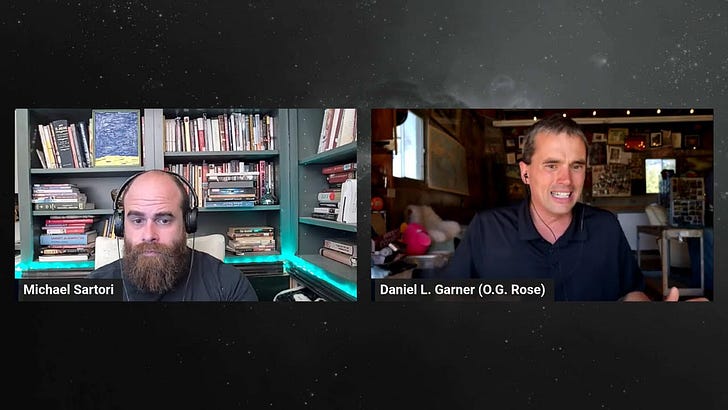
After several conversations discussing my book Tents Before Temples on his channel, I finally had the opportunity to speak with Daniel Garner of O.G. Rose regarding his own writing, specifically focusing on his collection of short stories, Under The Wing
The Appearance of Free Will & the Illusion of Progress
The metaphor of authorship provides a potential solution to the problem of determinism and free will, the “appearance” of which can also be understood as having real, but limited agency, and the nature of the self. It also addresses the role of divine election and human agency in regards to the different phenomenological experiences that occur among various Christians. Some individuals experience a sense of choosing while others strongly relate to being chosen. In the book metaphor, the fate of some characters must be predetermined to produce the desired outcome, while others are free to act according to their own wishes. The sense of resentment that this produces between the various camps ought to be mitigated by realizing what being “chosen” actually tends to entail. The upside is a sense of assurance regarding the existence of God and His nearness in the life of the believer; the trade-off is an increased likelihood of suffering, persecution, and martyrdom. Such “chosenness” is only retroactively verifiable, as history reveals the character of many tyrannical authorities who claimed to be chosen, and many heretics later vindicated to the status of sainthood.
This leads to the next critique, regarding the concept of progress. What I believe Magpie is pointing at is the kind of naive optimism of the early evolutionists who accepted the origin story of life randomly emerging from chemical soup, plotted the course from single-cell organisms to the advanced state of humans, and projected an upward trajectory on basically everything. This view is projected onto social progress by liberals and material gains by capitalists. Progress, even if the word is not used, is often treated as the solution to whatever problems currently exist. But as Thomas Sowell says, there are no solutions; only trade-offs; hence, progress is an illusion.
The Bible echoes this truth in the book of Ecclesiastes, with one important caveat, as it points to the exploration of every possibility of excess in virtue and vice to confirm the ultimate conclusion, that man is finite, but his source is not. Indeed, one can point to the life of Solomon as the useful exploration of the limits of chasing progress, as he brought the nation of Israel to the brink of collapse, a moment in which signs seemed to indicate continual growth and unrivaled success. The nation fractured under his son Rehoboam’s attempt to extract just a bit more GDP, cementing Solomon’s legacy as the wisest of kings, and the one not to imitate.
The metaphor of the author and his work expresses these same limitations. A novel does not “progress” in a developmental sense as utopians consider such things, but it does move from beginning to end in a teleological fashion. Yet this sense of linear progression is only representative of the experience from the perspective of the reader, or the characters within the story, not the author. In our conversation, Daniel discussed the familiar phenomenon of receiving the idea of a story in a gestalt image, its essence fully formed, even as many particulars remain undetermined. Such a vision may take on many forms depending on the circumstances of its execution, and the story can mimic the appearance of progress through various retellings; yet the essence of a story is constrained. These limits seem to be contained in the plot and characters. You can change the names, settings, and even the sequence of events, and a story can retain its essence. West Side Story is the same as Romeo and Juliet in a far truer sense than it is different.
This phenomenon also extends to stories that “evolve” over time. Two examples that I return to are The Last of the Mohicans, in which the 1992 film represents a completeness that surpasses the original text and the myriad of adaptations that preceded it, and Lancelot, who first arrives in Chretien De Troye’s clunky Knight of the Cart, and reaches his pinnacle with Mallory, against which later attempts to alter the course fall flat. Lancelot can take many different turns in his various journeys, but a Lancelot who avoids Guinivere to give Arthur a happy ending ceases to be Lancelot. In this way, progress is revealed to be something more like the telos of a seed; different gardens and different gardeners might grow better and worse tomatoes, but none of them can grow a fruit that is wholly different from the planted seed.
The teleology of the seeds is useful to discover the “plot” of the Christian story, which is not ultimately progressive, but multiplicative. For while we often consider the telos of the acorn to reach its heights in the oak tree, its journey is only complete when that tree produces acorns of its own. Thus, the ultimate telos of an acorn is many acorns, and the telos of the oak tree is many oak trees. Likewise, Christianity, in the incarnation, reveals the “plot” of creation in the doctrine of theosis, as described by Athanasius in the 4th century: “God became man so that man might become god.” While protestants tend to downplay this doctrine focus on present sanctification, the ultimate glorification of the saints remains an orthodox doctrine across all major Christian traditions.
The fact that this is idea “came all at once” is perhaps clearest in the book of Revelation, which contains both “a great multitude which no one could number, of all nations, tribes, peoples, and tongues, standing before the throne and before the Lamb, clothed with white robes,” and at the same time tells us that this lamb was “slain before the foundations of the earth”. The whole story is known to the author, while the character only encounters it in particular details and sequences. Encountering limitations makes our choices finite, but it does not invalidate the reality of our ability to choose, and evidence suggests that we are free to make some very foolish choices.
Combined with the birthing metaphors employed in various epistles, the agricultural and pastoral metaphors of Jesus parables on the kingdom, and the central metaphors of marriage, sonship, and adoption employed throughout scriptures, I believe the teleological arc displayed throughout both scripture and history provide a satisfactory answer to magpie’s other critiques, which I will address in subsequent posts, beginning first with the problem of overfitting, and secondly, “the need to rely on someone else to give you grace the way that Christianity demands.”