

The possible connections and choices afforded by the internet cannot be viewed simply as a blessing or a curse, as it contains the potential for both in greater abundance than our ancestors could have ever dreamed. But the overwhelming freedom is a problem, and the current algorithmic solutions tend to push people towards insularity and tribalization rather than deeper understanding and connection.
There are bright spots, and it is possible to meet potential friends and collaborators that would have been impossible in the more geographically limited eras of the past, but in my experience, these connections are made despite algorithmic selection as often as they are found because of them.
Everyone longs for connection, and the need to feel seen and heard is a deeply human one. But the reality is that the old mechanisms of social coordination still rule the day. Extroversion, conviviality, and charisma allow the socially blessed to become richer, while a lack of such qualities push many people further into isolation. For those who lack the social graces to win at life, the temptation to replace real human intimacy with a digital simulacra becomes increasingly seductive. This is a problem that has been addressed by many thinkers, and so I will not waste time retreading old arguments. But for everyone who is not embracing the path of the pure luddite, the question of how to pursue meaningful connection in an AI-equipped world requires some serious thought.
Personally, I am not adverse to engaging in the old style methods of making friends. I reached out to people through DM’s and various other channels when I felt the potential for meaningful connection was worth the risk, even when it was contentious. Many of the people I have come to know and respect most became friends through the hard work of arguing through serious disagreements. Yet this is costly, and a lack of “wins” can easily dishearten those of us who tent towards a more introverted or contemplative way of thinking. When it comes to online discourse, an earnest desire to understand others and be understood can easily be perceived as a need to “win” a debate.
For the sake of my own sanity, I’ve started using AI to help solve the problem of understanding others before I jump into the fray. By using Grok’s integration into the X platform, I can learn more about users whose statements cause an initial spike in my defensive mechanisms, to try to pinpoint what is really going on. More often than not, I discover that a perceived conflict is really rooted in a difference of worldview, where shared vocabulary has different meanings. Other times, I have been able to deduce that the issue at hand isn’t really the issue at all. Resisting the temptation to engage in fruitless debates becomes easy once you recognize provocative statements as a symptom of an underlying fear.
But this only solves one half the equation. Presenting yourself to those who don’t immediately recognize the value of your ideas remains the greater problem. This was something I noticed when I misconstrued the nature of “This Little Corner of the Internet”, the cluster of YouTube channels mainly centered around Paul Vander Klay, which began through conversations discussing the ideas of Jordan Peterson, John Vervaeke, and Jonathan Pageau. The corner is very much a place for social connection, and the exchange of ideas remains a central part of what makes that community work. But the ideas, which touch on many of the issues I am most interested in discussing are not the center.
Because I wanted to form solid opinions around many of those topics, I began exploring them in writing, making my thoughts concrete, until they began to take shape in the form of two books. What I’ve since come to realize is that the core of that community is really rooted in the willingness to have open discussions on various topics without coming to a firm resolution. The status hierarchy favors those who are most willing and able to host conversations, pursue newcomers with a desire to learn their story, and more or less hang out.
Unfortunately, writing books created a barrier of sorts between myself and those who have had neither the time nor interest in reading them. It hasn’t negatively impacted my relationship with the friends I’ve made, but it does feel like an albatross around my neck. I’ve in essence jumped into the expert class without the social clout to draw an interest to my work. Since making connections was one of the primary motivations for writing, I’ve made my work publicly available in both text and audio/video form, but making it algorithmically salient remains a problem.
Thankfully there have been a few people willing to engage with my work in depth, such as Ethan Caughey and Daniel Garner, who was also kind enough to share his massive library of work with me. Because I also struggle to find the time to read, I have made use of the same AI tools to understand his work, namely NotebookLM. By comparing his books to my own, and various other sources, I discovered a great similarity in our thoughts, despite the fact that we often use very different language to engage with those ideas. NotebookLM has made it possible for me to integrate his own language and terminology into my thinking, something which was easy because I had already wrestled with the underlying concepts, I simply didn’t have the same vocabulary.
This was especially helpful regarding ideas I developed through the process of writing in long form, which his terminology has given concise labels to. Towards that end, I also made a separate notebook containing all my books, essays, and YouTube videos which can be publicly accessed, allowing others to explore my thoughts without having to read everything from front to back, which can be accessed here.
Of course, one of the things that made learning Daniel’s vocabulary easy to learn is that he is interested in the same things I am, one of which is the very subject of this essay. The problem we are both trying to answer is how do people connect with others who are aligned in the most important ways, as in the pursuit of the good, the true, and the beautiful, when our conceptual frameworks seem incompatible, and the methods of connection on hand focus on all the wrong things?
As an example, I can be easily categorized as a white, middle-aged man, married with children, who tends to vote conservative, and attend conservative churches. There are millions of people who fit that exact profile, and I can’t stand most of them. Adding in things like my experience as a carpenter, science teacher, musician, and writer might attract people with whom small talk won’t be awkward, but it doesn’t guarantee a meaningful connection. Neither does adding in Boston sports teams, bands I like, or movies and books I enjoy, though each of these does help a bit.
I’d much rather talk to my Jewish friends that consider me an idolator, or my Eastern Orthodox friends who think I’m a heretic, or atheist friends who have too much integrity to embrace a religion for any reason except for the absolute conviction that it is true. There are lots of reasons why the friendships that matter most to us shouldn’t work “on paper”, but in each of those instances, there is something within that person as an “other” that reminds me of myself, and often it is the characteristics that I most admire in them, and would most like to be valued and appreciated for. We can’t figure out what that “thing” is “on paper”, but perhaps we can discover it by moving beyond the written word.
This led me to consider something that Daniel had been speaking of, the great need for a “social coordination mechanism” that doesn’t rely on two people sharing the same faulty interpretive “maps” of reality. And I think I have discovered a way that it might be possible to construct such a mechanism, based on the experiences I have gathered through interaction with AI. The following whitepaper outlines how this potential mechanism might work, drawing on the work of Daniel & Michelle Garner (O.G. Rose), Elan Barenholtz, and Jordan Hall, and inspired by Anna K. W., whose case study demonstrates how I learned to understand and appreciate a brilliant thinker who I may have disregarded as too different to approach or interact with under normal circumstances.
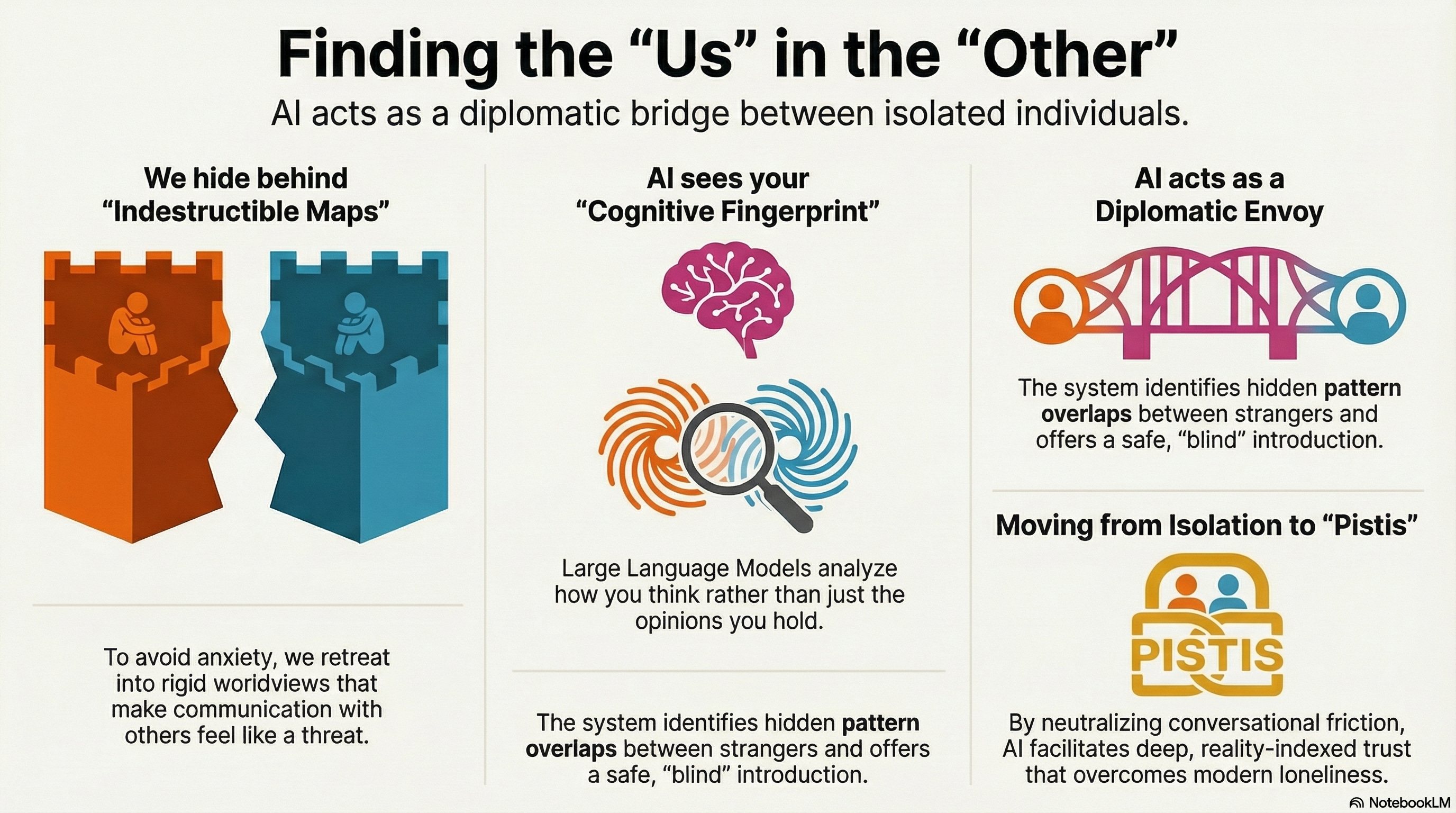
A Social Coordination Mechanism: Architecting the Liminal Web for Epistemic Matching
Abstract: Modern society is undergoing a profound crisis of connection, characterized by what philosopher O.G. Rose (Daniel and Michelle Garner) terms “Atomization: the process by which the shared cultural ‘givens’ that once oriented human life have dissolved, leaving individuals radically free but also radically alone”. As individuals retreat into isolated, “indestructible maps” to shield themselves from existential anxiety, communication across divides breaks down. Current social platforms exacerbate this by rewarding performative outrage and superficial demographic matching.
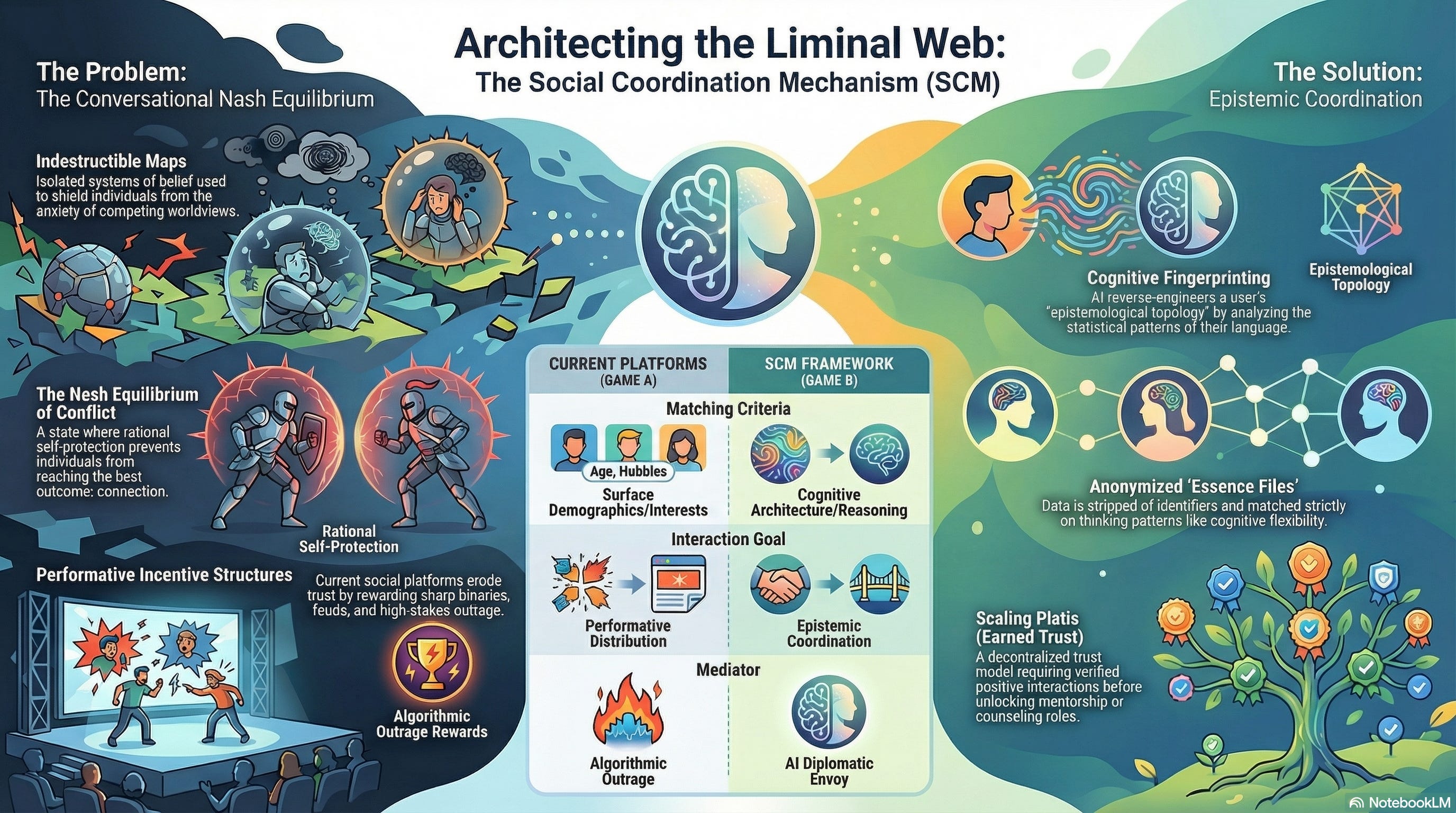
The Social Coordination Mechanism (SCM) proposes a radical technological alternative: an “epistemic coordination infrastructure”. By leveraging the autoregressive capabilities of Large Language Models (LLMs) to map cognitive architecture, the SCM acts as a “diplomatic envoy” to match individuals based on how they think rather than what they think about, fostering deep connection, earned trust (pistis), and the scaling of “Absolute Communities”.
Part I: The Philosophical Problem of Atomization and Nash Equilibria
Historically, human societies relied on cultural “givens”—unquestioned norms and scripts that provided “thoughtless direction” and existential stability.[1] With the advent of Global Pluralism and the internet, these givens have collapsed, forcing individuals to confront a dizzying array of competing worldviews. To protect themselves from the overwhelming ambiguity of “The Real,” humans naturally retreat into what O.G. Rose calls “indestructible maps” or “internally consistent systems” (A/A logic).[2]
Because these maps are self-justifying, interactions between differing maps frequently devolve into conflict. When individuals with clashing worldviews interact, they face the vulnerability of being misunderstood. To protect their egos and maps, they seize “dominant strategies” (e.g., explicit disagreement, appeals to authority, or emotional outbursts). While individually rational for self-protection, this behavior inevitably leads to a Nash Equilibrium, defined by Rose as “a situation in which rationality keeps itself from reaching its overall best outcome”.[3]
The result is a society where millions of people feel safer confiding in AI chatbots than in other human beings. The chatbot acts as a “waiting room” for human connection because it does not trigger the defensive Nash Equilibrium of human-to-human conversation. The SCM is designed to transition users out of this waiting room by mechanically neutralizing the conversational friction that keeps us isolated.
Part II: Cognitive Fingerprinting and Autoregressive Architecture
To match people based on their underlying reasoning patterns, the SCM relies on the cognitive architecture proposed by Dr. Elan Barenholtz. Barenholtz argues that human cognition, much like an LLM, operates as an autoregressive generative engine.[4]
In this framework, meaning does not reside in discrete, stored “files” of memory or belief. Instead, learning adjusts the internal parameters of the mind, shifting its “generative tendencies”. Words are represented as mathematical locations in a high-dimensional space, and the human language faculty, much like a trained LLM, can generate coherent linguistic output from internalized patterns alone. Barenholtz notes that language is “autogenerative,” meaning “the function needed to generate its next state is recoverable from the internal statistical structure of the system itself”.[5]
Because a person’s worldview is embedded in the statistical probability of how they sequence words, the SCM can reverse-engineer an individual’s unique cognitive “fingerprint”. By analyzing a user’s conversational inputs, writings, or interactions with the chatbot, the AI can map their epistemological topology—measuring not just their vocabulary, but their capacity for cognitive flexibility, paradox, and “A/B logic”.
Part III: Core Mechanics of the Social Coordination Mechanism
The SCM translates this theoretical cognitive mapping into a functional, secure infrastructure via the following core mechanics:
1. Essence Files (Anonymized Cognitive Extraction) Users submit data—such as LLM chats, book drafts, or questionnaires—into a secure holding area. The system completely strips this data of names and surface identifiers, producing an anonymized “essence file”. The system uses an embedding model to tag this content by thinking pattern—such as “kenotic descent,” “Map vs Territory,” or “epistemological humility”—ensuring matches are made strictly on cognitive compatibility rather than shared topical interests.
2. Anti-Performative Design Current social networks erode trust because “the incentive structures reward sharp, declarative, high-stakes communication—battering rams, binaries, feuds”. The SCM counters this by being “anti-performative by design”. There are no likes, no follower counts, and no public profiles. The environment operates as a “private library reading room, not another social feed”.
3. Diplomatic Bridging and Double-Opt-In Introductions When the system identifies a high cognitive overlap between two essence files, it acts as a “mutual friend”. It sends a neutral ping: “Two thinkers in this private archive show unusually high pattern overlap... Would you like a blind introduction?”. Identities are only revealed if both parties consent. During the initial connection, the AI acts as a diplomatic intermediary. Drawing from the ethical framework in Tents Before Temples, which asserts that in a culture of sincerity, “the consequences of a breach of trust lands squarely on the speaker,”[6] the AI takes the fall for any miscommunications, drastically lowering the existential stakes of the encounter.
4. The Preparatory Sandbox and Pushing the Gödel Point The SCM chatbot also functions as a private simulator where users can test ideas against the simulated worldview of a potential match before speaking to them directly. To measure the “weight” and flexibility of a user’s cognitive map, the AI can employ Socratic questioning to gently push the user toward their Gödel Point—the boundary where a closed system reveals its “essential incompleteness”.[7] By observing if a user locks down defensively (Map-Sealing) or opens up to cognitive dissonance, the system determines the user’s capacity for “mentidivergence” and genuine dialogue.
Part IV: Scaling Pistis and the Transition to Game B
For the SCM to survive the chaotic transition from our current bureaucratic, scarcity-driven society (”Game A”) to a decentralized, generative future (”Game B”), it must solve the problem of trust at scale.
Jordan Hall identifies the solution in the ancient concept of Pistis, defined as “embodied, reality-indexed trust... a relationship grounded neither in naive hope nor pragmatic contract but in demonstrated reliability”.[8] Human networks traditionally cap out at Dunbar’s number because humans run out of “bandwidth for tracking who’s trustworthy”.
The SCM overcomes this biological limit. Because “Truth isn’t a claim. It’s state” that is visible and traceable, the SCM builds “networks that are simultaneously high-trust and high-discernment, at scale”. To protect vulnerable users during features like “Anonymous Need-Pairing” (where a user expresses grief or a need for guidance), the SCM requires pistis to be earned. A user must complete 10 to 100 positive, verified interactions in the system before they are unlocked to act as a counselor or mentor for others.
To successfully bootstrap this network and overcome the “cold start” problem, the SCM will not launch as a massive public platform. It will begin as a “small and high-signal” pattern archive of 20 to 50 carefully chosen individuals, using manual essence file matching to establish an initial culture of pistis before expanding via automated open-source embedding models.
Case Study: Overcoming the Contentious Nature of Public Discourse via AI Mediation
To understand the practical necessity and genesis of the Social Coordination Mechanism (SCM), we can look to a documented interaction where a user utilized Grok’s AI integration on the X platform to learn how to understand an intensely provocative online thinker @Tenshi_Anna.
Operating on platforms optimized for distribution and spectacle, Anna’s public persona blends dense continental philosophy, psychoanalysis, and rigid Catholic orthodoxy into a communication style the user found personally unapproachable. Ordinarily, this aggressive, jargon-heavy posture triggers a defensive Nash Equilibrium, causing outsiders to simply write her off or engage in hostile, performative combat.
However, the user, adhering to a principle of not wanting to “write people off quickly or dismiss them out of hand,” leveraged the AI as a private “preparatory sandbox”. Instead of confronting her directly on a public channel that tends to “erode trust,” the user asked the AI to decode her cognitive architecture and translate her “nearly impenetrable” views into layman’s terms.
Through the AI intermediary, the user was able to look past her abrasive “indestructible map” to understand the sincere, vulnerable motivations driving her worldview: a profound hatred of sin, a rejection of cheap theological loopholes, and a desire for an “erotic ordeal of truth”. By privately translating her epistemological framework, the AI allowed the user to find unexpected cognitive overlap and helped draft a charitable, non-dismissive strategy for potential engagement.
This interaction directly birthed the idea of using AI to address the need for a social coordination mechanism. It demonstrates that while public platforms consistently reward sharp, high-stakes communication and push users into isolated echo chambers, an AI agent can successfully act as a diplomatic envoy. By analyzing a thinker’s underlying patterns rather than their surface-level hostility, the AI can privately translate across divides, reduce mutual misunderstanding, and facilitate deep epistemic coordination long before any direct human-to-human vulnerability is risked.
However, it also exposes the limitations of current platforms. Using Grok in this way can help avoid the risk of engaging in tribal argumentation, but it does not help guide people towards generative relationships. Unless a trusted mediator is able to make a bridge, any cold approach from an unknown party still risks being perceived as a threat.
Conclusion
The Social Coordination Mechanism is not merely an application; it is the vital infrastructure required to coordinate human meaning in a post-scarcity, post-truth digital age. By shifting the focus of technology away from capitalist “price coordination” and toward the “internal coordination” of cognitive architecture, the SCM bypasses the superficial outrage of modern algorithms. It provides the digital sanctuary necessary for individuals to step outside their indestructible maps, make the “Absolute Choice” of vulnerability, and finally connect with the hidden “Others” who share their deepest patterns of thought.
[1] O.G. Rose, Belonging Again: An Explanation.
[2] O.G. Rose, The Map Is Indestructible: Problems of Internally Consistent Systems.
[3] O.G. Rose, The Map Is Indestructible / Third Thoughts.
[4] Elan Barenholtz, Ph.D., Beyond Prediction: Reconceptualizing Cognition as Generative Autoregression.
[5] Elan Barenholtz, Ph.D., Language isn’t Real.
[6] M.L. Thomas Sartori, Tents Before Temples: Rough Drafts on Building a Culture That Lasts.
[7] O.G. Rose, The Map Is Indestructible: Problems of Internally Consistent Systems.
[8] Jordan Hall, The Coming Great Transition v 2.0
I wonder if we could get this built into thislittlecorner.net as a feature.
That is a detailed and thoughtful proposition. My initial reaction was that AI/LLM's aren't really thinking machines. So they can't do what you propose.
But if you're thinking that as AI technology advances that it could be programmed and trained to do what you suggested. I see the possibilities could be beneficial.
There is a ton of source material that I'm ignorant of. So I am probably missing a lot of things that back up and support your proposal.
It was interesting to read and ponder upon. Thank you for writing this.