

A rainy Saturday presents an almost perfect opportunity for writing in my house. Almost perfect, because the peace and quiet will inevitably be broken by the cries of children declaring a grave injustice in three small words: “That’s not fair!”—perfectly normal and to be expected among sisters. But spend any significant time observing online discourse, be it in politics, dating, or religion, and you will discover a majority of young (and not so young) adults are fighting with the same childish tactics. They have matured physically, but are still running on a schoolyard script.
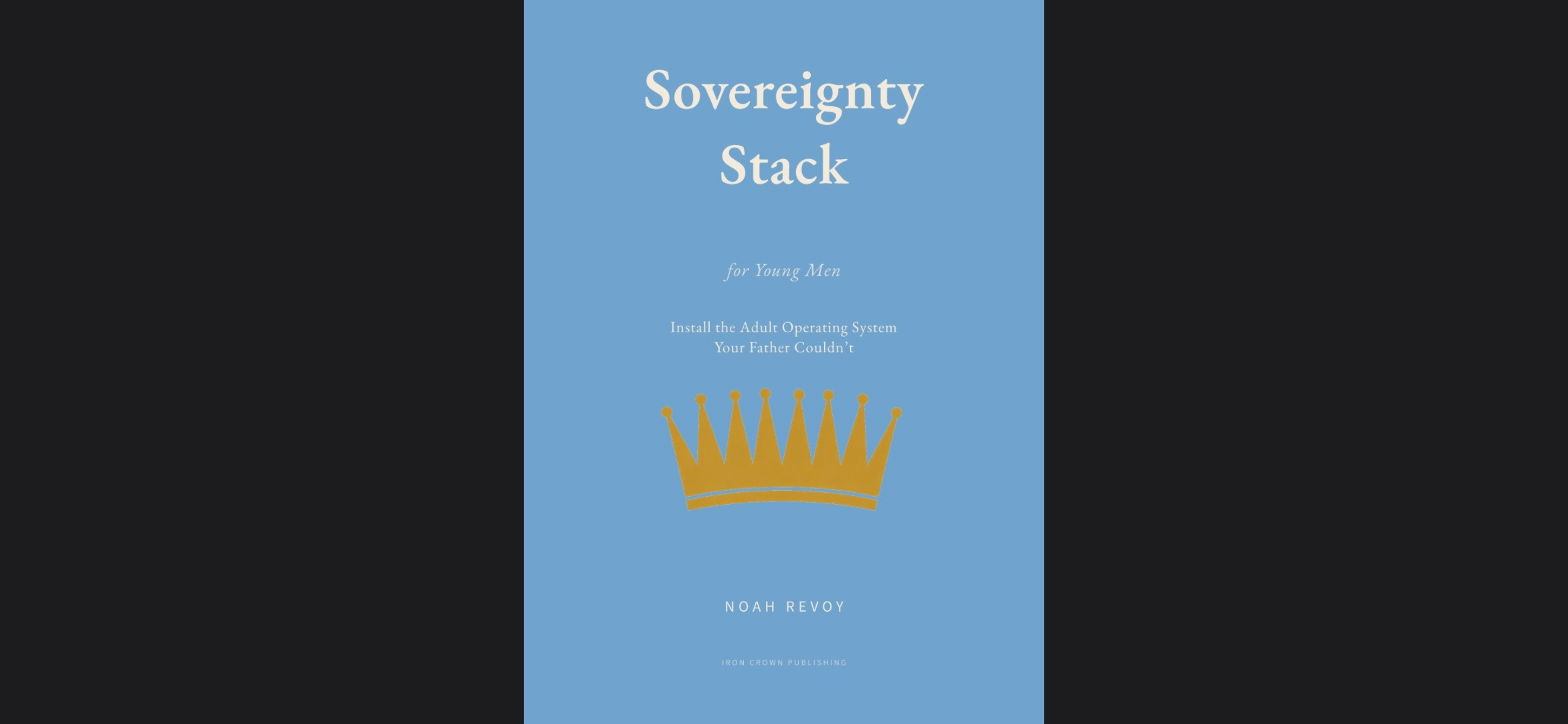
The solution is to upgrade to an Adult Operating System, and this is what Noah Revoy is offering with Sovereignty Stack for Young Men, a book and course designed to help people identify and move beyond the patterns of thought and behavior that keep them stuck.
Installing The Adult OS
Sovereignty Stack for Young Men teaches a system of eight core competencies that each build on one another, and guide the user through the OODA loop - a practice that consists of four steps; Observe, Orient, Decide, and Act. When working properly, this cycle produces accurate results and feedback that guides the user towards their goals in an upward spiral.
This process is an intuitive and natural part of how we learn, and it explains how we gain our most basic skills from speech to walking, to making friends and playing games. It runs unconsciously in many areas of our lives as we progress from infancy to adulthood. Yet in an age when shared cultural values are rapidly dissipating, we can no longer rely on the old structures of family and local communities to instill the skills needed to navigate in an increasingly pluralistic world. This is where the eight competencies come into play.
Beginning with The Inner Observer, the practitioner steps back from automatic and unconscious reactions, to become purposefully aware of their thoughts and actions. Once someone becomes aware of what they are thinking, feeling, and doing, they can begin to control their responses through Impulse Modulation, and Emotional Modulation. These first three competencies allow the user to begin working the OODA loop to their advantage, as they are no longer caught spinning in endless reactionary circles between observation and action–the pattern of behavior epitomized by toxic online discourse.
The next step is Epistemic Updating, the process through which old beliefs and assumptions can be tested, corrected, or discarded, if they no longer produce helpful insight. Once these old, unconsciously adopted ways of thinking are revealed, the user can begin the work of Reality Correspondence: creating new models based on accurate observations of what works in the real world.
With the ability to make an accurate assessment of reality, the user can take the next critical steps towards maturity. Constraint Subordination is the process of identifying and accepting the immovable limits that reality imposes without resentment, so that energy can be redirected towards the areas where change can occur. Only then can the blame game finally be retired through Responsibility Internalization, the posture of owning the outcomes of your choices.
These first seven competencies all work together to improve the functionality and feedback of the OODA loop. The final skill, Strategic Volition, provides the capacity to choose a meaningful direction for your life. It helps you discover what values inspire you to pursue goals with a sustained effort. Once the user masters these eight competencies, they have successfully installed the Adult OS.
The Book: Sovereignty Stack for Young Men
I encountered Noah Revoy’s work fairly recently on X, among a batch of accounts I began following in preparation for an upcoming work on dating and marriage. I am always a bit skeptical of the claims of online gurus, and I’m especially wary of people marketing themselves through extractive economic techniques.
However, I was impressed with the wisdom and maturity he regularly injects into the blame games of perennial online debates, and his willingness to share his new book spoke of a confidence in his work that made me intrigued. I was even more impressed with the speedy resolution of an issue with the download code. These positive interactions played a significant role in pushing the book up my list of priorities. What really sold me is the content of the book itself.
Sovereignty Stack for Young Men is written in a stellar format that follows the continuous stories of four young men, whose lives each reflect common circumstances that keep young men stuck. Throughout the book, we see the same young men work through each of the eight competencies, gradually improving their circumstances through purposeful effort. As Revoy explains:
“I put these men in the book because storytelling teaches what explanation cannot. A principle stated abstractly slides past you. A principle you watch a real person live through, struggle with, fail at, and work back from, installs at a different depth. These arcs exist so the work in this book reaches you through the part of your mind that remembers people, rather than the part that files facts.”
This narrative framework is not only compelling, but effective. I could easily see past and present versions of myself in the lives of each young man. Seeing the tangible results of making deliberate choices in manageable steps is believable and encouraging. Witnessing the inner observer at work in each chapter helps the reader learn how to evaluate progress and mistakes.
On a practical note, the narratives also do a remarkable job of holding the reader’s attention. I found myself opening the e-book frequently because I was curious to find out what would happen to each of the young men. Specifically, I was very invested in the fate of commitment-wary Marcus and his girlfriend Kate. Spoiler alert—the courtship, while lacking romantic flair, highlights the more crucial virtues of honesty and integrity, and happily concludes with a wedding.
Why This Book Matters
I have been deeply invested in solving the formational crisis that is afflicting young men for quite some time. This interest came first in reflection on my own life, as I sought to understand what my parents did right, successfully transmitting the importance of their faith and values, in contrast to many of my peers. It became a full blown passion through the revelation of fatherhood, which opened my eyes to the unconscious disdain of responsibility that permeates so much of our culture, even among communities of faith.
Later crises caused me to reflect on the areas my parents fell short in preparing me for the complexity of adult life. When my wife and I faced the prospect of starting over in a new state with no jobs and no assets, I harbored momentary resentments that I was not pushed down the four-year college track. Yet the same resentments are equally common among my peers that pursued that exact route, and the outcomes are often worse for those saddled with enormous debt and equally poor job prospects. Because I had already developed many of the skills outlined in this book, I could see that my parents were not uniquely responsible for this failure; it was a problem caused by applying an outdated map to an ever changing landscape.
Fast forward seven years, and the skills developed by helping my father as a Pastor and handyman, in an environment geared towards self-education and creativity provided the basis of a very fulfilling life. At the same time, I was deeply frustrated by the fact that I learned so many of the most vital skills outside of the environment that ought to take them most seriously–specifically, the church. This set me on a path of researching the significant role played by concrete things like economics, policy, and architecture, alongside more abstract concepts like philosophy, religion, and their expression in the arts, music and stories.
I envisioned my first book, Tents Before Temples, as a kind of curriculum that could be employed alongside practical training in trade skills. By examining different facets of cultures from many sides, and showing my work by publishing “rough drafts”, it is a work meant to hone many of the competencies outlined in Sovereignty Stack. My second work, The Way of the Tekton, is more focused on the development of those values within local communities.
To use the terminology of Mr. Revoy, these works are highly focused on honing the skills outlined in the latter half of the book, reality correspondence, epistemic updating, restrain subordination, responsibility internalization, and strategic volition. What I did not feel qualified for, (especially with an inner observer that tells me my own thinking is very atypical,) was writing a work that focuses specifically on the development of the individual.
This is where Sovereignty Stack is vitally important, for several reasons. For one, it is written in a morally neutral tone. It does not ground its authority in scripture or a faith tradition, though it does assume a basic set of values that are consistent with Christianity. Health and fitness, fulfilling work, friendship, marriage and family are all viewed as obvious goods. This is a common sense starting point for a culture suffering deeply from the deconstruction of every value other than autonomous individualism. One need not explain why pornography is bad to those who are intimately aware of its negative consequences.
The other valuable aspect of this work is the precision and clarity of the terms and their descriptions. These aspects of the Adult OS are hardly new, as Revoy points out, Marcus Aurelius articulates how to employ The Inner Observer in his Meditations, and these same skills are employed in the Psalmist’s prayer; “Search me, O God, and know my heart; test me and know my anxious thoughts. See if there is any offensive way in me, and lead me in the way everlasting.”
Starting fresh avoids the problems associated with semantic drift and negative associations. It clears away the mistranslations of the map to allow the reader to observe the raw territory of their own life clearly.
Suspending moral judgment also allows the observation function of the OODA loop to actually do its work to produce real results. We can see this when we apply such thinking to less offensive habits. People don’t fall into a moral panic because they grabbed a Snickers bar at the cash register. The dispassionate view point allows the observation step in OODA to work clearly, even when applied to pornography:
You decide to quit watching porn. Day one goes fine. You feel the conviction, the resolve, the clean feeling of a fresh start. Day two, the algorithm serves you a suggestive image you did not search for. You did not go looking for it. It found you. You feel the pull. You resist. Day three, you are bored, alone, and your phone is right there. You resist again. Day four, you had a terrible day. Your boss talked to you like you were an idiot. Or your mother asked when you are going to get a real job. It is midnight and you are lying in bed and the phone sits on the nightstand. This time you do not resist.
You did not fail because you are weak. You failed because you burned through your daily supply of impulse override on exposures you did not need to have. The algorithm, the phone on the nightstand, the unstructured alone time, the absence of any alternative activity, the accumulated stress of the day: each one cost energy, whether or not you successfully resisted. By midnight, the tank was empty. The man who put the phone in another room before bed, who installed a content filter, who had plans that evening instead of sitting alone, who ate well and slept the night before: he did not need more willpower than you have. He needed less, because his environment was doing the work.
This does not make pornography an amoral topic. What it does help reveal and identify how the moral culpability is distributed. If consuming pornography is immoral, so too is producing it, promoting it, and engineering systems and algorithms designed to hijack reward systems. As is the creation of a culture that despises masculinity and seeks to limit the development of personal agency among young men.
As the book points out, many of those things are outside the control of the individual. Recognizing this fact is necessary to help funnel our energies towards the things we can control. It also allows both the individual and those around them to celebrate small wins. This is the only way to create the kind of positive feedback loop that can go from this:
…a pause between trigger and response. The pause is small. Three seconds. Enough to notice the phone in his hand and choose something else. The first week, he manages it twice out of seven nights. The third week, four out of seven. The gap is opening. Kate notices before he tells her. She does not know what changed. She knows something did.
To this:
The porn is gone. Not through willpower. Through replacement. The evening window that used to belong to the phone now belongs to Kate, or to the book, or to sleep. The impulse still surfaces occasionally. He notices it, owns it, lets it pass. The pause that began as three seconds is now automatic. The shame has dissolved. Not because he forgave himself in some ceremonial way, but because the behavior stopped and the man who performed it is no longer the man brushing his teeth in the mirror.
A framework and set of tools that delivers these kinds of results is far more valuable than a less effective tool that ticks all the right ideological boxes. Those who have found success through other methods should have no problem mapping Revoy’s terminology onto the language of their own traditions.
Personal Reflections
In the first chapter there was one passage that raised my suspicion slightly:
The fact that the transmission failed has become the default for young men your age. Most of them are unprepared: unprepared for careers, for relationships, for leadership, for any form of serious life. That is terrible for the majority. It is excellent news for you, because it means you are about to become one of the few who are prepared.
In a world where almost no one has the Adult OS installed, having it furnishes you an asymmetrical advantage over everyone who does not. You are building a capability that most people around you will never develop. That advantage compounds over time. Every year you operate with these competencies installed while others do not, the gap widens in your favor.
One of my major concerns within modernity is the scarcity mindset that assumes a zero-sum outcome for every human interaction. It’s an unhealthy view of competition that fuels the extractive economics of the internet. But as this is the mindset through which many young men will no doubt begin this book, I can understand the appeal, and appreciate the function it serves in the fuller context of the book.
Revoy later states that the real power lies in Cooperative Sovereignty, “the capacity to build with others, to contribute to families and communities and institutions, to exercise the will to power in service of something larger than yourself.” This is where my own attention has been focused, as someone who has been working in and around churches for most of my life.
Purposeful cooperation multiplies the reach and effectiveness of individuals. It’s the means through which a single man transmitted the first version of the Adult OS to groups of three, twelve, and seventy two into a movement that radically reshaped the Roman Empire, and built the modern world. But the narrative examples in Sovereignty Stack reveal how much that personal transmission has been attenuated over time. The church plays a minor role in the lives of two mothers across the stories of the four young men, and I think that’s a fair portrayal of its significance in our day and age.
One may encounter individuals operating with a high degree of personal sovereignty in many churches, but more often than not, wielded as an asymmetrical advantage held by the few against the majority. But more often than not, it’s simply lacking, and as Revoy rightly states, “You cannot cooperate effectively until you can govern yourself. You cannot lead until you can follow your own direction. You cannot build for others until you can build for yourself.”
Restoring Norms to Revitalize Exceptions
Perhaps the most valuable takeaway I received from this book is the clear articulation of the role that personal agency plays in achieving whatever goals we set for our life. It cuts through the fog of excuses and reveals the path of action in easily digestible steps. It’s an excellent guide for developing the tools to become a generalist. The ability to learn and hone new skills is a lifelong asset that outperforms specialization in novel fields—the most valuable skill set for navigating an uncertain future.
The internet draws our attention to the top .001% performers in every field, to people whose success is dependent on exceptional circumstances that they are often unaware of. There are many famous and influential people that operate with extreme deficits in some of these competencies. This is not a manual for becoming an elite athlete or a celebrity influencer. That is a feature, not a bug. The Adult OS reflects a normative vision for a functional human life. It’s a baseline from which exceptional departures can actually be seen as meaningful.
This is true of Christianity as well. Jesus makes extreme demands in the Sermon on the Mount. Loving your enemies, resisting violence, turning the other cheek. But these statements have become meaningless in a world dominated by victims who have come to expect such sacrifice from everyone, constantly screaming “That’s not fair!” When such demands become ubiquitous, they produce hollow virtue signals, not genuine sacrifice. It is only when the kind of maturity taught in Revoy’s work becomes normative that such costly departures can regain the power they once held.
In the end, the book is not so much about gaining an asymmetrical advantage over a field of competitors for limited jobs and dating prospects. That’s a marketing pitch designed to make online influencers wealthy at the expense of their followers. Revoy speaks honestly about the challenge that road presents:
“You could apply what you learned from this book on your own. That is a legitimate path. It is also the hardest and the slowest, and most men who attempt it fail, not because the knowledge is insufficient but because the distance between knowing what to do and doing it is the exact problem the book just described.”
Such honesty reveals that Revoy has a passion for young men and genuinely wants them to succeed. This is a work best suited for individuals who see the value in engendering cooperative trust.
I would wholeheartedly recommend Sovereignty Stack to any church or pastor with a desire to take the crises affecting boys and men seriously. It would be an invaluable addition to any kind of discipleship curriculum. For individuals without a support setting, Noah offers a year long course with a free two-week trial. I plan to sample the course at a later time, and will likely write another review. He does a good job pitching the course and I expect it’s well worth the money.
The course is tailored to four separate audiences, young men and mature men, and young and mature women, with unique editions of the book to be released at a later date. As a mature man married to a mature woman, with daughters and a son, I plan to read all of them once they are released. For now, I plan to reread the young men’s edition with my wife, as I think it offers a helpful language for shared discussion.
A Final Note
As an experiment, I used Notebook LM to extract the questions posed in the text and compare it to 192 of my published books, articles, and videos; most of which contain a fair degree of personal reflection. I asked the AI to give me a personal assessment of my strengths, and identify my binding constraints.
It highlighted impulse Modulation and Emotional Modulation as the areas least addressed. (I also take on too much responsibility for myself.) This is not a shock as I recently came to recognize my place “on the spectrum”, but after reading Sovereignty Stack, I can see the value in working to improve these shortcomings, even if I may never reach the level of mastery achievable for others. Flaws such as these are remedied best by purposeful effort and strategic cooperation, not excuses.
You can find the book and the course at:
Huh, that's fascinating. I'll share this article with some men who might be interested in you and the book you did the review on. Sounds like it's a good book.
Christianity has failed to protect the patriarchy amongst other things.